

Product GuidesBy Ahmed Tayeh
Free Electrical Calculators for Australia: Which One to Use When
Every free CableHero calculator in one guide: what it answers, the standard it works to, and which one to reach for, with a worked example that runs one circuit through three of them.

CableHero has 21 free electrical calculators for Australian work, plus single line diagram software. They cover cable sizing, voltage drop, derating, conduit fill, cable pulling, protection, motors, solar and the everyday conversions, and each one that works to a standard names it: AS/NZS 3008.1.1:2025, AS/NZS 3000:2018, AS/NZS 5033:2021 or IEEE Std 1185-2019, plus IEC 60947-4-1 for motor currents and IEC 60909 for transformer fault level. Every calculator on the calculators page works without an account.
This guide follows the six groups on that page. For each tool it covers the question it answers, the standard behind it and when to use it. After that comes a worked example that runs one circuit through three of the calculators, then the mistakes we see most often when people use calculators like these.
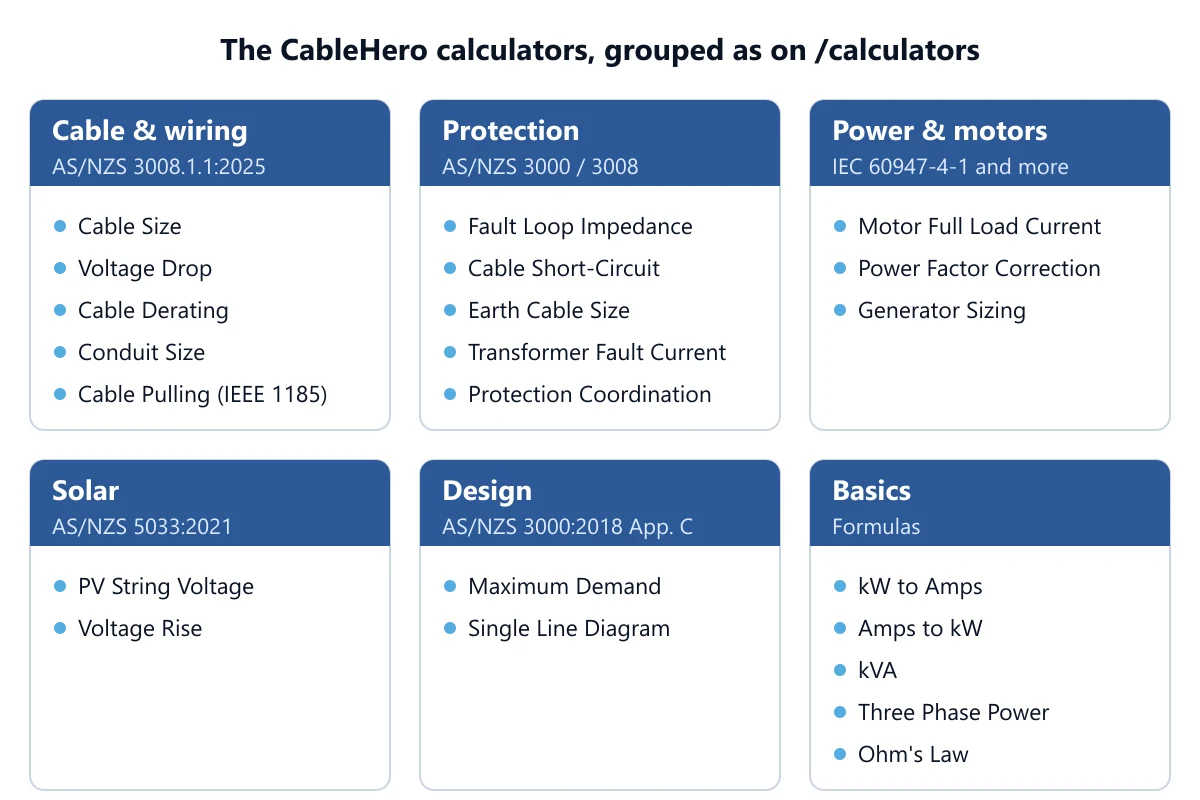
What the free electrical calculators cover
Each calculator answers one question and shows how it got there. A short worked example and a "how it is calculated" section on each page set out the formulas and the table numbers. That matters because a number you cannot trace is a number you cannot defend to an inspector or a reviewer.
Most pages also link to the related tools. A cable size result, for example, points you to the derating, voltage drop and fault loop calculators.
Cable and wiring
This group sizes the cable, derates it, and gets it into the conduit.
Cable Size Calculator
The Cable Size Calculator is the core tool. Enter the load (in amps, watts, kW or HP), the supply, the length of run, the cable type and the installation method. It picks the smallest cable that meets three checks:
current-carrying capacity from the AS/NZS 3008.1.1:2025 tables;
your voltage drop limit;
short-circuit withstand at the fault level and fault time you enter.
Turn protection on and it also checks the fault loop impedance against the circuit breaker. It reports the active, neutral and earth sizes, the operating temperature and the spare capacity.
The public calculator sizes loads up to 50 A free of charge; larger loads need a paid plan. Guests can download a watermarked PDF report.
Voltage Drop Calculator
The Voltage Drop Calculator works out the drop in volts and percent for a cable you have already chosen, and compares it with the 5% limit in AS/NZS 3000:2018. Use it to check an existing run or a long final subcircuit. Our post on voltage drop limits in Australia explains how the 5% is usually shared between consumer mains, submains and final subcircuits.
Cable Derating Calculator
The Cable Derating Calculator combines the AS/NZS 3008.1.1:2025 correction factors:
grouping (Tables 3.33 to 3.43);
air and soil temperature (Tables 3.44 and 3.45);
depth of laying (Tables 3.46 and 3.47);
soil thermal resistivity (Table 3.48).
It multiplies them into one overall factor that you can carry into the cable size calculator. Use it whenever cables share a tray, conduit or trench, or the ambient is above the standard's reference.
Conduit Size Calculator
The Conduit Size Calculator checks conduit fill to AS/NZS 3000:2018 from the cables you list and their overall diameters. It gives the smallest conduit that fits them.
Cable Pulling Calculator
The Cable Pulling Calculator builds a conduit route from straights, slopes and bends. It works out the pulling tension and sidewall bearing pressure section by section to IEEE Std 1185-2019, and you can view the route in 3D. Use it before a long or bendy pull, not after the cable has jammed.
Protection
These tools check that the circuit clears a fault: the transformer fault level, the loop impedance, short-circuit withstand and the earth.
Fault Loop Impedance Calculator
The Fault Loop Impedance Calculator compares the circuit's earth fault loop impedance (Zs) with the maximum for a B, C or D curve circuit breaker. That maximum is Uo divided by the current that trips the breaker instantly, per AS/NZS 3000:2018. Long final subcircuits on C-curve breakers are where this check bites. Our fault loop impedance post covers the background.
Cable Short-Circuit Calculator
The Cable Short-Circuit Calculator applies the adiabatic equation I²t = K²S² with K factors from AS/NZS 3008.1.1:2025 Table 5.1. It tells you whether a cable survives the fault current for the clearing time, or the minimum size that does.
Earth Cable Size Calculator
The Earth Cable Size Calculator reads the protective earth size from AS/NZS 3000:2018 Table 5.1, then checks it against the fault.
Transformer Fault Current Calculator
The Transformer Fault Current Calculator estimates the prospective fault current at the LV terminals from the kVA and percentage impedance, using a simplified IEC 60909 method. Use that figure for switchgear kA ratings and as the fault level in the cable size calculator.
Protection Coordination Calculator
The Protection Coordination Calculator plots upstream and downstream devices on one time-current chart. It checks discrimination, cable withstand and disconnection to AS/NZS 3000:2018. It knows B, C and D curve MCBs, MCCBs with adjustable settings, electronic trip units and gG fuses, and you can add custom devices.
Power and motors
Motor Full Load Current Calculator
The Motor Full Load Current Calculator converts motor kW to amps and lists typical full load currents per IEC 60947-4-1 next to the calculated value. Use it before you have the nameplate, then check against the nameplate.
Power Factor Correction Calculator
The Power Factor Correction Calculator sizes a capacitor bank in kVAr to lift the power factor from its present value to a target. It rounds to whole capacitor steps and shows the current saved.
Generator Sizing Calculator
The Generator Sizing Calculator works out generator kVA from the running load and the largest motor start. Motor starting, not running load, is what usually decides the size.
Solar
The PV String Voltage Calculator works out Voc and Vmp at the site's coldest and hottest temperatures, from the module's temperature coefficients. It checks them against the AS/NZS 5033:2021 limits.
The Voltage Rise Calculator covers the AC side: the rise between the inverter, generator or other exporting equipment and the point of supply.
Design
The Maximum Demand Calculator applies AS/NZS 3000:2018 Appendix C, Tables C1 to C3. It works out the demand for a house, a block of units or a non-domestic installation, phase by phase. Use it before choosing consumer mains or asking the distributor for supply capacity.
The Single Line Diagram Software is the drawing tool. With a free account you can draw an SLD and link each cable to its saved cable calculation, so the cable schedule on the sheet follows the calculations. The free account includes one project, one calculation and one drawing; previewing and exporting drawings are part of the paid plan.
Basics
These are the everyday conversions.
kW to Amps and Amps to kW for single-phase, three-phase and DC.
The kVA Calculator converts between kVA, kW and amps at any power factor.
The Three Phase Power Calculator gives kW, kVAr and kVA in total and per phase, for star or delta.
The Ohm's Law Calculator solves for any two of voltage, current, resistance and power.
The formulas are the standard ones. For three-phase: I = P × 1000 ÷ (√3 × V × cos φ), with V the line-to-line voltage. For single-phase, drop the √3 and use the phase voltage.
Which calculator to use when
New circuit, known load: kW to Amps (or Motor Full Load Current), then Cable Derating, then Cable Size. Turn protection on in the cable size calculator to check the fault loop at the same time.
Existing cable, new load: Voltage Drop for the drop, then Cable Size with "manual" size to check its capacity.
New supply or upgrade: Maximum Demand first, then Cable Size for the consumer mains, and Transformer Fault Current if you own the transformer.
Switchboard design: Transformer Fault Current for the kA rating, then Protection Coordination for discrimination between the main switch and the outgoing circuits.
Solar or battery job: PV String Voltage for the array, Cable Size (DC, PV array circuit) for the string cables, Voltage Rise for the AC side.
Underground or long conduit runs: Conduit Size for the fill, Cable Pulling for the tension. See underground cable sizing in Australia for the derating side.
Worked example: one circuit through three calculators
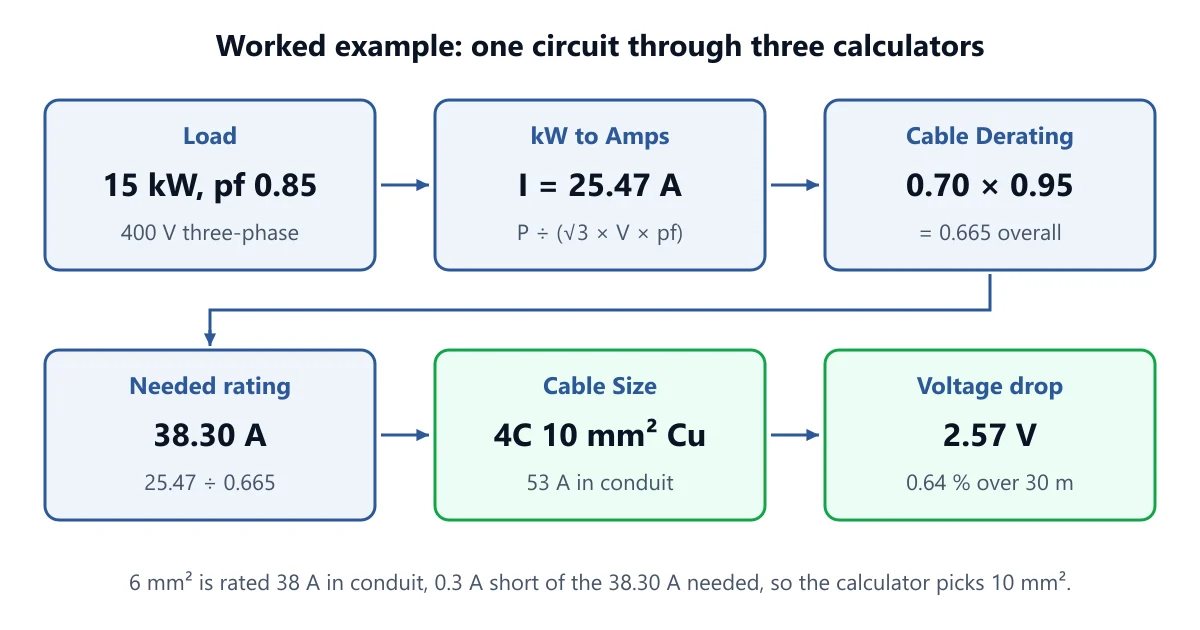
Take a 15 kW three-phase air-conditioning unit with a power factor of 0.85, fed at 400 V over a 30 m run. The cable is a four-core XLPE copper cable in conduit in air. It shares the conduit with two other loaded circuits, and the plant room reaches 45 °C.
Step 1: kW to amps
I = 15 000 ÷ (√3 × 400 × 0.85) = 25.47 A. The kW to Amps Calculator also shows 17.65 kVA and 9.30 kVAr.
Step 2: derating
In the Cable Derating Calculator, choose bunched, enclosed, with three circuits. Table 3.33 gives 0.70.
For air at 45 °C with a 90 °C cable, Table 3.44 gives 0.95, which is √((90 − 45) ÷ (90 − 40)) rounded to two places. The overall factor is 0.70 × 0.95 = 0.665.
Step 3: cable size
In the Cable Size Calculator, enter:
load 15 kW, power factor 0.85, three-phase, 400 V, 30 m;
multicore cable, copper, XLPE (90 °C);
installation method "enclosed wiring enclosure in air";
overall derating factor 0.665;
fault level 2000 A and fault time 0.1 s.
The cable must have a tabulated rating of at least 25.47 ÷ 0.665 = 38.30 A. Table 3.19 rates 6 mm² at 38 A for this method, so it misses by 0.3 A. The calculator selects 10 mm², rated 53 A, and reports a voltage drop of 2.57 V, or 0.64% over the 30 m.
With the derating left at 1 and everything else the same, the calculator would pick 6 mm². That is the whole case for running the derating step every time.
Common mistakes
Leaving the derating factor at 1. Grouping and ambient are the usual reasons a cable runs hot. Our post on ignoring cable derating factors shows what it costs.
Picking the wrong installation method. A cable clipped in air and the same cable buried in ceiling insulation can be two or three sizes apart. The method is a choice in the calculator, not an afterthought.
Leaving the fault level at the default. The cable size calculator starts at 3000 A and 0.1 s. In the example above, that default alone calls for at least 6.64 mm² of copper for short-circuit withstand, so the result is 10 mm² whatever the derating. Enter the real prospective fault current and clearing time.
Checking voltage drop against the whole 5% on every circuit. The 5% runs from the point of supply to the load. Mains, submains and final subcircuit share it.
Treating a typical motor current as the nameplate. Use the IEC 60947-4-1 figures for early design only.
FAQ
Are the CableHero calculators really free?
Yes. Every calculator on the calculators page works without an account. The cable size calculator is free for loads up to 50 A; larger loads, saving more than one calculation and exporting drawings need a paid plan, which starts with a free trial.
Which edition of AS/NZS 3008 do the calculators use?
New cable calculations use AS/NZS 3008.1.1:2025, the current edition. The calculation report lists the edition and the tables and clauses behind each result.
Can I get a report to hand in?
The cable size, voltage drop, voltage rise, conduit, maximum demand and cable pulling calculators let guests download a watermarked PDF. A free account saves calculations to a project, and the report then downloads without the watermark.
Do the calculators replace engineering judgement?
No. They apply the tables and formulas consistently and show their working, but you still choose the installation method, the derating conditions and the protective device. Check manufacturer data where it differs from the standard's generic values.
Start with the circuit in front of you
Open the calculators page and pick the tool for the question you have now. For the example above, start in the Cable Size Calculator:
enter 15 kW at 0.85 power factor, three-phase 400 V, 30 m;
choose multicore XLPE copper in conduit in air;
type 0.665 as the overall derating factor;
set the fault level to 2000 A and the fault time to 0.1 s.
You should see 10 mm². Then change the derating back to 1 and watch it drop to 6 mm², with 4.28 V (1.07%) of voltage drop. It takes about a minute.
Work it out for your circuit
Free calculators, no sign-up needed.
Related articles
Continue reading more articles on this topic.

Product GuidesAhmed Tayeh
Understanding CableHero PDF Reports for Certification & Tendering
Accurate and compliant electrical documentation has never been more important du…
Read more: Understanding CableHero PDF Reports for Certification & Tendering
Product GuidesAhmed Tayeh
Effective Ways to Create AS/NZS-Compliant Single Line Diagrams
Single-line diagrams (SLDs) are simplified schematics that represent an electric…
Read more: Effective Ways to Create AS/NZS-Compliant Single Line Diagrams
Product GuidesAhmed Tayeh
How CableHero Ensures Calculations and Results are AS/NZS 3008 and 3000 Compliant
The AS/NZS 3008 and AS/NZS 3000 help ensure the safety, reliability, and complia…
Read more: How CableHero Ensures Calculations and Results are AS/NZS 3008 and 3000 Compliant