Every new home connection in Australia starts with the same question: how much power will this house actually draw? That number is called maximum demand, and it determines everything downstream:
- The size of the supply cable
- The rating of the switchboard
- Whether the local network even has capacity to connect you
Get the calculation wrong, and the consequences range from an undersized cable that trips under load to a connection application that gets bounced back by the distributor. Get it right, and the rest of the electrical design falls into place.
This guide walks through what residential maximum demand actually means, how to calculate it under AS/NZS 3000, and where electricians and designers most often go wrong.
What Is Maximum Demand in a Residential Context?
Maximum demand is the highest level of electrical load a property is expected to draw at any one time. It's not the sum of every appliance's rated wattage added together.
In practice, nobody runs their oven, ducted air conditioning, hot water system, and every power outlet at full capacity simultaneously. Maximum demand accounts for this by applying diversity: the assumption that not all loads operate at once, or at full rating, for extended periods.
For new home connections, maximum demand is what your electricity distributor uses to:
- Size the service cable and metering equipment
- Confirm the local network transformer and feeder have enough spare capacity
- Set the connection agreement terms for the property
The Standard: AS/NZS 3000 and Appendix C
In Australia, residential maximum demand is calculated in accordance with AS/NZS 3000, specifically Appendix C. This appendix sets out standardised methods so that every electrician, designer, and distributor arrives at a consistent, defensible number.
Appendix C organises electrical loads into load groups, each covering a category of equipment:
- Load Group A: Lighting
- Load Group B: Socket outlets (10A and 15A)
- Load Group C: Ranges, cooking appliances, and other fixed loads over 10A
- Load Group D: Motors
- Load Group E: Air conditioning and space heating
- Load Group F: Water heaters
- Load Group G: Other fixed appliances
Each group carries its own diversity factor, reflecting how likely that category of load is to be operating at full capacity at the same time as everything else in the house.
For a standard single domestic installation, the relevant reference is Table C1, which sets out the simplified method for calculating maximum demand in a typical home.
Two Methods for Calculating Residential Maximum Demand
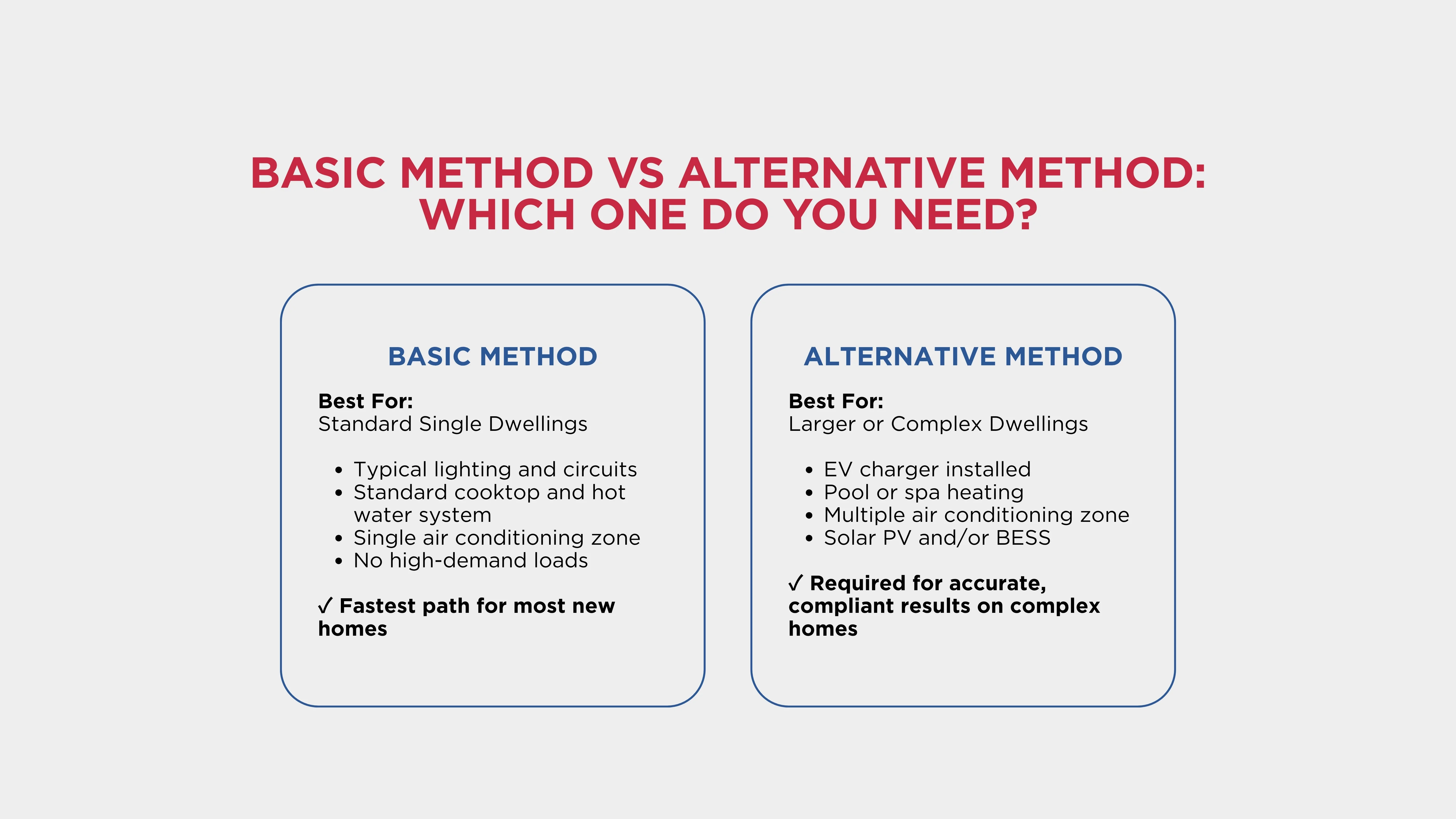
- The Basic Method: It applies standard diversity allowances to each load group without requiring a detailed breakdown of every individual circuit. This is the method most electricians use for a typical single dwelling with standard appliances.
- The Alternative Method: The alternative method is used where a home has an atypical load profile. It requires a more granular, circuit-by-circuit assessment, applying diversity factors to each specific load rather than relying on the simplified table.
For most new single-dwelling connections, the basic method is sufficient. Larger or more complex homes, those with EV chargers, pools, or multiple air conditioning zones, increasingly need the detailed method to get an accurate, compliant result.
How Is Residential Maximum Demand Calculated?
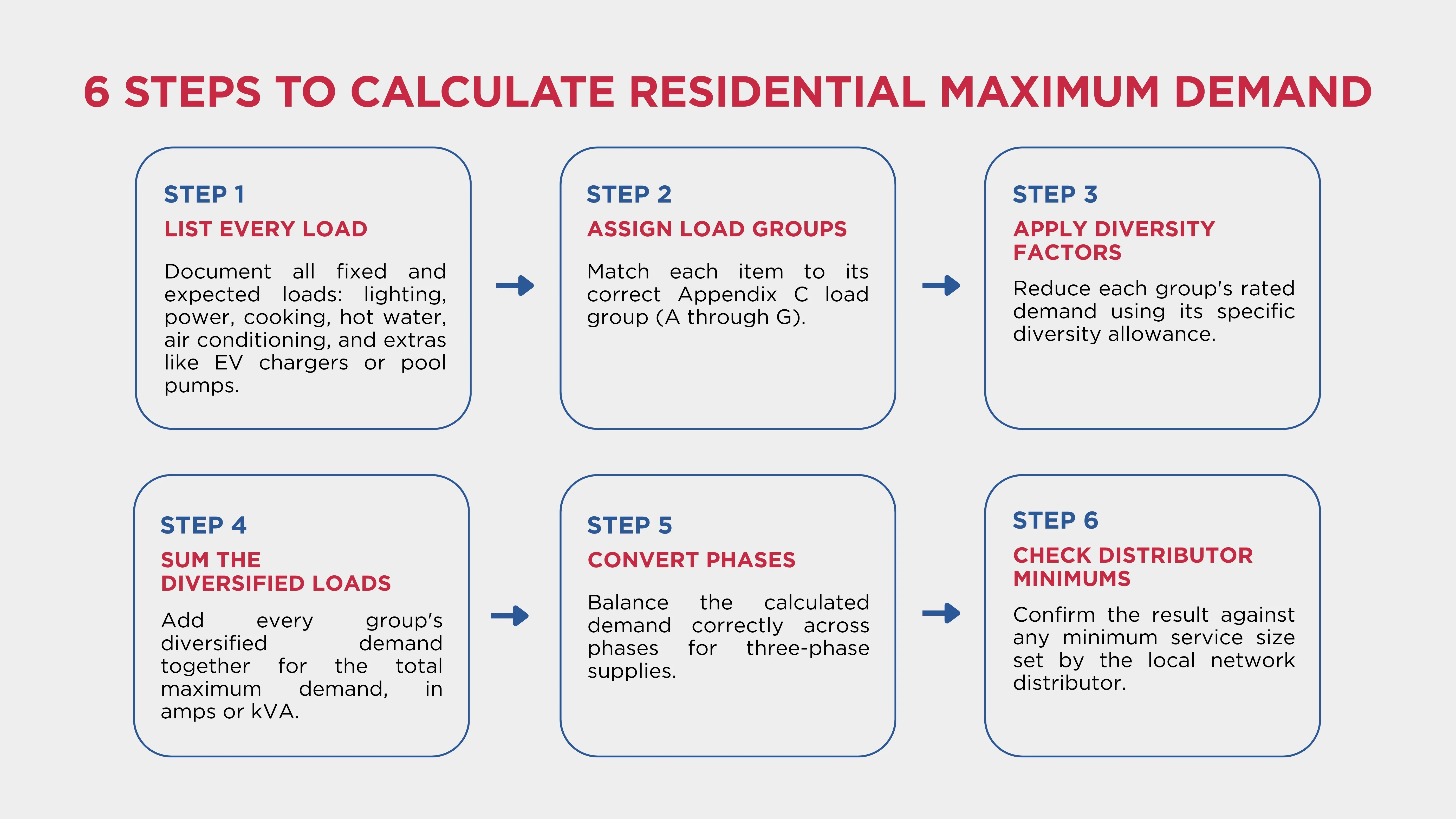
- Step 1: List Every Fixed and Expected Load. Document lighting circuits, general power outlets, cooking appliances, water heating, air conditioning, and any other fixed equipment (pool pumps, EV chargers, spa heaters).
- Step 2: Assign Each Load to Its Correct Load Group. Match every item to the relevant Appendix C load group. This determines which diversity factor applies.
- Step 3: Apply the Diversity Factor for Each Group. Each load group's rated demand is reduced according to its diversity allowance, reflecting realistic simultaneous use rather than full-rated capacity.
- Step 4: Sum the Diversified Loads. Add the diversified demand from each load group together to arrive at the total maximum demand for the installation, typically expressed in amps (A) or kilovolt-amps (kVA).
- Step 5: Convert Between Single-Phase and Three-Phase Where Required. If the supply is three-phase, the calculated demand needs to be distributed and balanced across the phases correctly, not simply divided by three.
- Step 6: Cross-Check Against the Distributor’s Minimum Supply Requirements. Some network distributors set minimum service sizes regardless of the calculated maximum demand, particularly where solar PV or future EV charging is likely.
What Are the Common Mistakes in Residential Maximum Demand Calculations?
- Using Connected Load Instead of Diversified Demand: Adding up every appliance's full rated wattage produces a wildly oversized figure and leads to unnecessarily large cable and switchboard specifications.
- Forgetting Future Loads: Homeowners increasingly add EV chargers, pool heating, or battery storage after the initial connection. A maximum demand calculation that doesn't allow any headroom for likely future loads can force a costly service upgrade.
- Misapplying Diversity Factors Across Load Groups: Diversity factors are group-specific. Applying a blanket diversity allowance across all loads, rather than the correct factor for each group, produces an inaccurate result.
- Incorrect Single-Phase to Three-Phase Conversion: Miscalculating how demand splits across phases can lead to unbalanced loading, which distributors will reject.
- Skipping Documentation: Distributors and certifying authorities expect a clear, traceable calculation. An undocumented "rule of thumb" figure is not compliant and can delay connection approval.
New connections carry more scrutiny than like-for-like replacements or minor upgrades, because the distributor has no existing supply history to reference. Every figure in the application has to be justified from first principles.
A well-documented, correctly calculated maximum demand submission moves through a distributor's connection process faster. It gives the assessor everything they need to confirm network capacity without follow-up queries.
Get the Calculation Right Every Time with CableHero
Manually working through Appendix C's load groups, diversity factors, and phase balancing for every new home connection is time-consuming, and it's easy for a small error to compound into an incorrect final figure.
CableHero's Maximum Demand Calculator is built specifically for AS/NZS 3000 compliance:
- Applies the correct diversity factors by load group automatically
- Handles single-phase and three-phase conversions
- Generates a detailed, distributor-ready report
Rather than working the whole calculation from a printed Appendix C table, you enter the property's loads and get a compliant, documented maximum demand figure in minutes, with a paper trail that holds up if a distributor asks questions.
Once maximum demand is confirmed, CableHero carries that figure straight into cable sizing and voltage drop calculations, so your service cable, submain, and switchboard selections are all built on the same consistent number.
FAQ
What's the difference between connected load and maximum demand?
Connected load is the sum of every appliance's full rated capacity added together. Maximum demand applies diversity factors to reflect how a home is actually used, since not every appliance runs at full rating simultaneously. Maximum demand is always lower than connected load, and it's the figure distributors and cable sizing calculations actually rely on.
Which table in AS/NZS 3000 applies to a standard new home connection?
For a typical single domestic installation, Table C1 in Appendix C of AS/NZS 3000 sets out the simplified basic method for calculating maximum demand. More complex homes, or those with atypical loads like EV charging or multiple air conditioning zones, may need the detailed alternative method instead.
Do I need to recalculate maximum demand if a homeowner adds solar, a battery, or an EV charger later?
Yes. Any significant change to a property's load profile can shift the maximum demand figure enough to require a reassessment, and potentially a service upgrade. It's worth building some headroom into the original calculation if these additions are likely.


 Cable Sizing