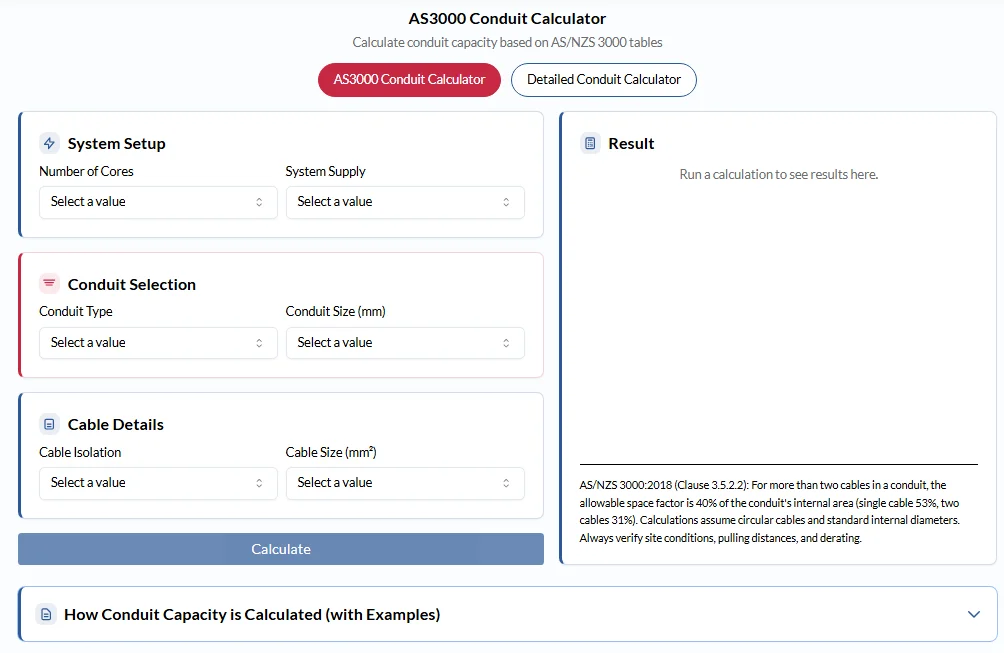
Conduit Size Calculator

Free conduit fill calculator to AS/NZS 3000:2018 Appendix C

How to use
Create a free account to save to a project Sign up to save

Conduit capacity and conduit size for AS/NZS 3000:2018 Appendix C, from the tables or the cable and conduit diameters.

Method

Conduit capacity from the AS/NZS 3000:2018 Appendix C tables.

System Setup

Conduit

Cable

Conduit Capacity

Choose the conduit size and the cable size to see how many cables fit.

How it's calculated

Conduit fill and the jamming check

The detailed calculation compares the cables' total area with the conduit's internal area at the AS/NZS 3000:2018 space factor.

Cable area

overall cable diameter, mm (insulation and sheath included)
cables of that diameter

Space factor (Appendix C, C6)

conduit internal diameter, mm
one cable
two cables
three or more cables

Smallest internal diameter

The calculator picks the smallest conduit of the chosen type whose bore is at least .

Jam ratio

Three equal cables can wedge side by side in a bend in that range. It is reported with the next size clear of it; the fill limit still decides the size.

Standards referenced

  • AS/NZS 3000:2018 Appendix C, Clause C6 and its tables of the maximum number of cables in conduits
  • Conduit internal diameters from the manufacturers' datasheets for each conduit type

Worked example: three 4 mm² 2C+E TPS cables

Three 4 mm² 2C+E TPS cables, 11.5 mm overall, in heavy duty rigid UPVC conduit.

  1. 1. Cable area
  2. 2. Space factor
  3. 3. Minimum bore
  4. 4. Smallest conduit
  5. 5. Jam ratio

40 mm conduit meets the 40% space factor, but its jam ratio of 2.94 is in the 2.8 to 3.2 range, so the three cables could wedge in a bend. Pull them as one laid-up bundle, or step up to 50 mm (jam ratio 3.76).

Frequently Asked Questions

Conduit Fill Questions Answered

Do I use the copper cross-section (CSA) or the overall cable diameter for conduit fill?

Use the overall outside diameter of the cable, including insulation and sheath. The conductor size (for example 6 mm²) is the copper cross-section and is not used for conduit fill; a 6 mm² cable is about 7 to 8 mm overall.

What space factor applies to a conduit?

AS/NZS 3000:2018 Appendix C (C6) sets the space factor against the conduit's internal area: 50% for a single cable, 33% for two cables, and 40% for three or more cables.

What is the difference between the table lookup and the detailed calculation?

The table lookup reads the maximum number of cables of one type and size for each conduit size from the AS/NZS 3000:2018 Appendix C tables. The detailed calculation works from the conduit's internal diameter and the cables' overall diameters with the space factor, so it covers cables and conduits the tables do not list.

What is cable jamming in a conduit?

Three cables of the same size can wedge side by side in a bend when the ratio of the conduit's internal diameter to the cable's overall diameter is between about 2.8 and 3.2. The calculator flags that range as a warning; the fill limit still decides the conduit size.

Is the conduit calculator free?

Yes. Anyone can use it without an account. A free account lets you save the result to a project and download the PDF report.

Reviewed by Ahmed Tayeh, electrical engineer at CableHero. The calculator is a design aid: the designer remains responsible for checking the installation against the standards.

Guides

Learn the method

How to use this calculator

Enter the cables by type or by diameter and find the smallest conduit within the space factor.

Read the guide: How to use the conduit size calculator

More free tools

Other calculators

Size the Cables Too

Pair the conduit with an AS/NZS 3008.1.1:2025 cable size calculation, and keep both in the same project.