Electrical Compliance Documentation: What You Need for Certification in Australia
07Aug
Ahmed Tayeh
Electrical Compliance Documentation: What You Need for Certification in Australia
Every electrical installation in Australia must be documented before it can be certified as safe and legally compliant.
However, this is simpler than the reality. Because while the underlying standard applies across the country, the certificate names, submission requirements, inspection processes, and regulatory authorities that give it legal force differ between every state and territory.
For electricians and engineers working across state borders this complexity is a genuine risk. Submitting the wrong certificate, missing a testing record, or referencing the wrong standard amendment can mean a failed inspection, a delayed energisation, or a legal liability.
This guide covers every document required for electrical compliance certification in Australia, what it is, what it must contain, and how it differs by jurisdiction.
The Foundation: AS/NZS 3000 and AS/NZS 3017
Before discussing specific documents, understand the two standards that govern what must be done, and what must be documented.
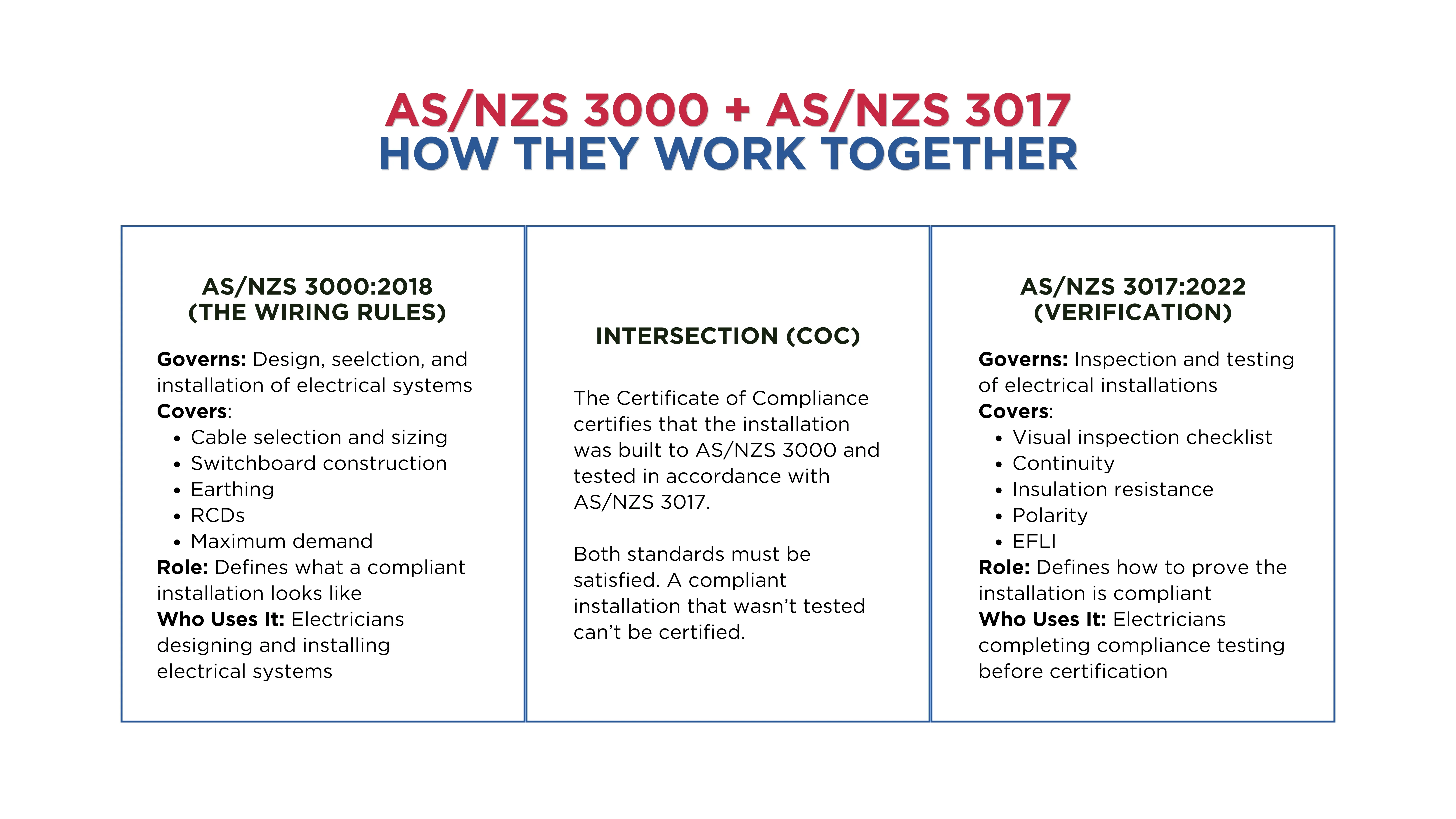
AS/NZS 3000:2018 specifies how electrical installations must be designed, selected, and installed. The current edition is AS/NZS 3000:2018, with three published amendments: Amendment 1 (2020), Amendment 2 (2020), and Amendment 3 (2025).
AS/NZS 3017:2022 specifies the testing and inspection process that must be completed before any new or modified electrical installation is energised. This outlines the testing sequence and documentation requirements before energising electrical installations.
C11.3.webp372.45 KB You cannot have one without the other. A perfectly installed factory power system means nothing legally if it has not been rigorously tested, and you cannot successfully test a system that was installed outside the approved rules.
What Electrical Compliance Documentation is Needed in Australia?
Document 1: Certificate of Compliance (CoC)
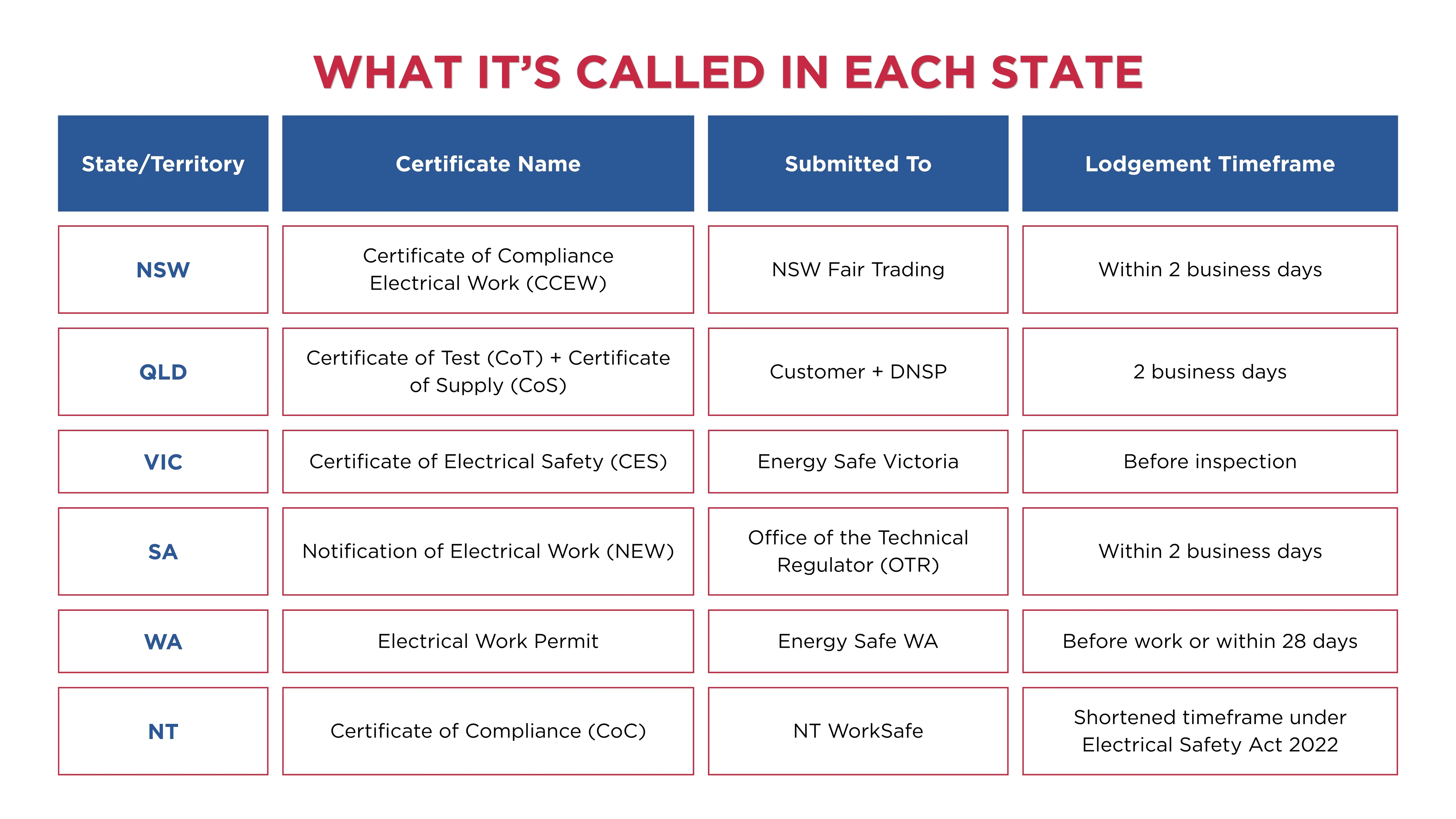
An Electrical Certificate of Compliance (CoC), also known as a CCE, COES, CCEW or notification, depending on your state, is a mandatory legal document. It certifies that electrical work complies with Australian Standards and proves the work was tested and is safe for use.
Every state and territory requires a CoC for electrical work, but the name and scope vary:
New South Wales: Certificate of Compliance Electrical Work (CCEW), issued by the licensed electrical contractor responsible for the work. Required for all electrical installation work. Submitted to Ausgrid, Endeavour Energy, or Essential Energy as part of the new connection or supply upgrade application.
Queensland: Electrical Safety Certificate (ESC), sometimes called a Certificate of Compliance. Issued by the licensed electrical contractor. For new connections, a Notice of Work must be lodged with the DNSP before work commences, and the ESC must be submitted after completion.
Victoria: Certificate of Electrical Safety (CES), issued by the Registered Electrical Contractor (REC) through Energy Safe Victoria's online portal. The CES must be lodged within seven days of completing any notifiable work.
South Australia: Certificate of Electrical Work (CEW). Maintaining verified compliance, documented via an Electronic Certificate of Compliance (eCoC), is essential to satisfy the Office of the Technical Regulator (OTR), mitigate business insurance liability, and avoid severe SafeWork SA penalties.
Western Australia: Electrical Safety Certificate (formerly called Certificate of Compliance). Issued by the Registered Electrical Contractor through the ATCO or Western Power connection portal.
Northern Territory: Certificate of Compliance (CoC). Under the new Electrical Safety Act 2022, a CoC is required for all electrical work, except for like-for-like replacements. The electrical licence types needing to complete a CoC has expanded and the timeframe to complete and provide a CoC has decreased.
Australian Capital Territory: Certificate of Compliance, submitted to ActewAGL or Icon Water for new connections.
Tasmania: Notice of Electrical Work, submitted to TasNetworks.
What a CoC Must Contain
Requirements for a valid Certificate of Compliance include: all electrical work must comply with the Wiring Rules (AS/NZS 3000) and other relevant standards; the electrician must test the work, ensure it complies with safety standards, and issue the certificate.
A properly completed CoC must include:
The licence number of the electrician or contractor responsible
The property address and description of work completed
The standard(s) the work was verified against
A declaration that the work has been tested in accordance with AS/NZS 3017
The CoC is a declaration. The test results are the evidence behind that declaration.
AS/NZS 3017:2022 specifies a mandatory sequence of visual inspection and instrumental tests that must be completed before any electrical installation is energised. These test results must be documented and retained, and in many jurisdictions, submitted alongside the CoC or made available on request.
The mandatory tests under AS/NZS 3017:2022 include:
Continuity of Protective Earth Conductors. Every protective earth conductor from the final subcircuit to the main earth bar must be tested for continuity. Discontinuity means the protective earthing system cannot clear a fault safely.
Insulation Resistance. Measures the resistance of cable insulation between conductors and between conductors and earth. A reading below 1 MΩ indicates damaged or contaminated insulation that may cause a leakage current or fault.
Polarity. Confirms that active, neutral, and earth conductors are connected to the correct terminals throughout the installation. Incorrect polarity can leave exposed conductive parts at active potential.
RCD Operation — Trip Current and Trip Time. Every RCD in the installation must be tested to confirm it operates within the AS/NZS 3000 limits: 30 mA trip threshold for personal protection RCDs, and a maximum trip time of 300 ms at rated trip current.
Earth Fault Loop Impedance (EFLI). Measures the impedance of the complete fault current path from the supply source, through the active conductor, through the fault, and back via the protective earth conductor. The EFLI must be low enough to ensure that a phase-to-earth fault generates sufficient current to trip the protective device within the disconnection time required by AS/NZS 3000.
Prospective Short-Circuit Current (PSCC). Where required, a measurement of the maximum fault current available at the switchboard; used to verify that all protective devices are rated to interrupt the maximum fault current at their installation point.
Document 3:Design Documentation and Calculations
For commercial, industrial, and large-scale electrical projects, the CoC and test results alone are insufficient. Design documentation is required to support the CoC and to demonstrate that the installation was designed in compliance with AS/NZS 3000 before it was built.
Maximum Demand Calculation
Every new connection or supply upgrade requires a maximum demand calculation submitted to the DNSP as part of the connection application. The calculation must follow the methodology in AS/NZS 3000 Appendix C, applying the correct load category rules from Table C1 (domestic) or Table C2 (non-domestic) to determine the realistic concurrent demand on the supply.
DNSPs use the maximum demand figure to confirm the requested supply size is appropriate for the installation. A maximum demand that appears significantly oversized for the building type will be queried and a supporting calculation demonstrating the methodology will be required. Cable Sizing Calculations
For commercial and industrial projects, cable sizing calculations demonstrating AS/NZS 3008.1.1 compliance are required. These calculations must show that every cable satisfies:
Current-carrying capacity
Voltage drop
Short-circuit withstand
Neutral and earth conductor sizing
AS/NZS 3000 calls up AS/NZS 3008 for cable sizing. The cable sizing calculations are the technical evidence that the selected cables are compliant, and they are the first document an inspector or certifier requests when querying a non-standard installation. Single-Line Diagram (SLD)
A single-line diagram showing the electrical architecture of the installation is required for most commercial and industrial installations. The SLD must show protective device types and ratings, cable sizes, and the arrangement of earth and neutral bars.
For installations requiring RCD protection, the SLD must demonstrate the RCD configuration, including how RCDs are distributed to achieve the selectivity required by AS/NZS 3000.
Document 4: DNSP and Supply Authority Submissions
Connecting to the DNSP network requires specific documentation beyond the CoC, the content and format of which varies between network operators. New Connection Application
All new supply connections require a formal application to the DNSP, including:
The CoC (or CCEW equivalent)
Maximum demand calculation
Proposed supply size and configuration
Property address and lot details
Metering details
Metering Notice of Completion In some jurisdictions, a separate Notice of Completion or Metering Completion form must be submitted to the DNSP's metering coordinator before the meter can be installed and the supply energised. Solar PV AS/NZS 4777.1 and AS/NZS 5033 Documentation
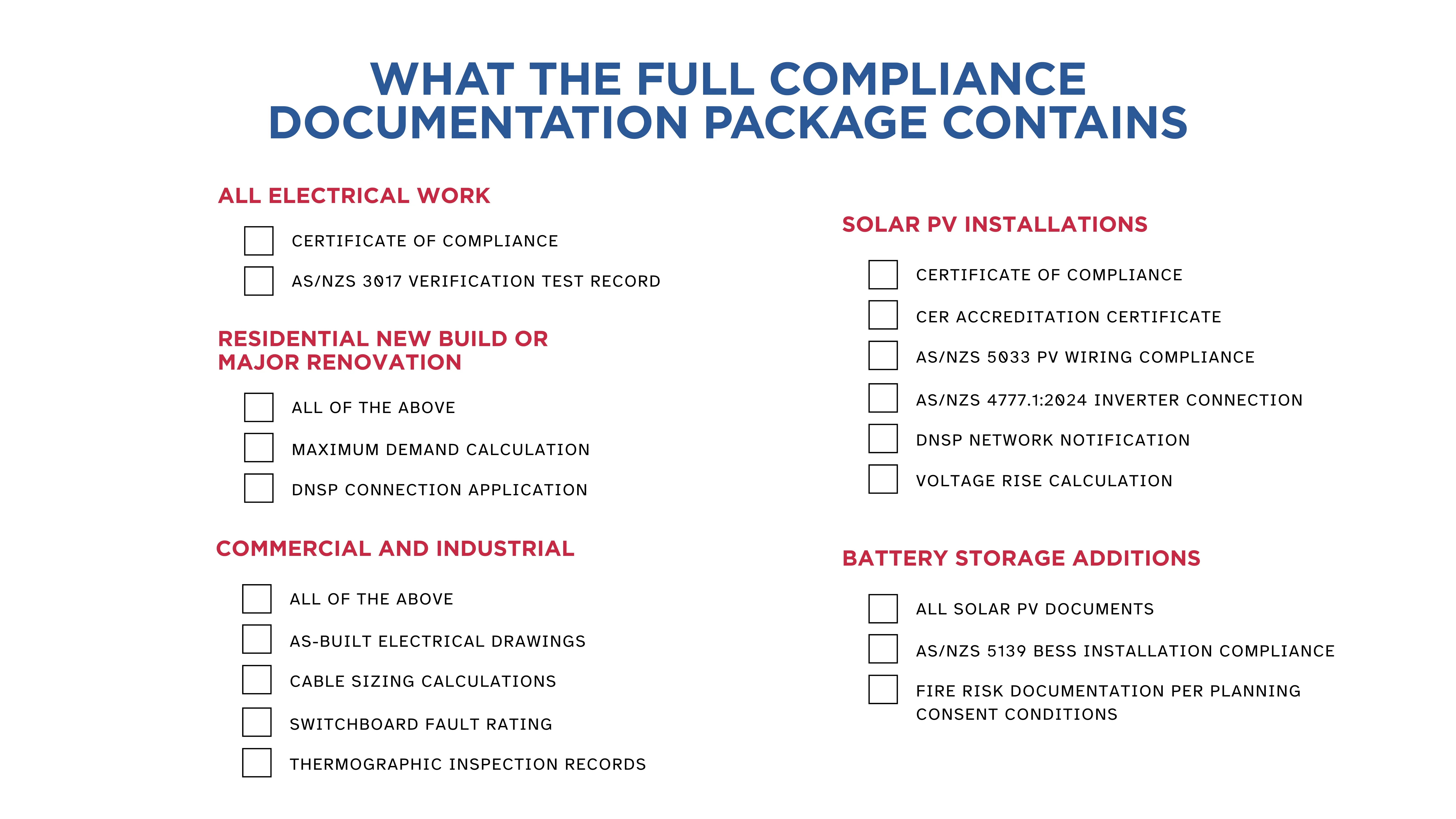
Solar PV installations require additional compliance documentation beyond the standard CoC:
AS/NZS 4777.1:2024 Compliance: The inverter must be listed on the Clean Energy Council's approved products list and the installation must comply with AS/NZS 4777.1. This includes the 2% voltage rise limit from the inverter to the point of supply and the high-export-voltage protection requirements introduced in the 2024 edition.
AS/NZS 5033:2021 Compliance: The DC string cable sizing must comply with AS/NZS 5033:2021, including the 3% recommended / 5% maximum voltage drop from the most remote PV module to the PCE input. From June 2026, this sizing must use the dedicated DC cable tables in AS/NZS 3008.1.1:2025.
Electrical Safety Certificate for Grid-Connected Solar: In addition to the standard CoC, most DNSPs require a specific solar installation notification form, confirming the inverter details, export level, and protection settings.
CER Small-Scale Technology Certificate (STC) Documentation: For systems eligible for STCs, the system must be installed by a Clean Energy Council Accredited Installer, and the system data must be submitted to the CER's online portal to create the STCs. Installation documentation must demonstrate compliance with all relevant standards.
Document 5: Installation Records and As-Built Documentation
For commercial and industrial projects, installation records and as-built documentation form part of the compliance package and are retained for the life of the installation.
Cable Schedule: A cable-by-cable register showing every circuit in the installation: cable type, size, route, from/to locations, and voltage drop. The cable schedule provides the traceability between the cable sizing calculations and the physical installation.
Switchboard Schedule: A circuit directory for every switchboard and distribution board, listing the circuit identifier, protective device type and rating, and the load it serves. Required under AS/NZS 3000 and typically affixed to the inside of the switchboard door.
As-Built Drawings: The single-line diagram and any detailed wiring diagrams updated to reflect the installation as actually built, including any deviations from the design drawings made during construction.
Test Instrument Calibration Records: Calibration certificates for all instruments used during AS/NZS 3017 testing, confirming the instruments were within calibration at the time of testing.
Australia's electrical safety regulations are complex. Each state and territory enforces additional licensing requirements, inspection rules, and local amendments. An electrician licensed in New South Wales may not automatically be recognized in Queensland without re-certification.
The key jurisdictional differences that affect compliance documentation:
Certificate Name: CCEW (NSW), ESC (QLD), CES (VIC), CEW (SA), ESC (WA), CoC (NT/ACT), Notice of Electrical Work (TAS); the same underlying document has seven different names across eight jurisdictions.
Submission Portal: Each state uses a different online submission system. Victoria uses the Energy Safe Victoria ESC portal. SA uses the OTR's electronic CoC system. NSW submissions go through the relevant DNSP's connection portal.
Inspection Requirements: Some jurisdictions require a proportion of electrical work to be inspected by the electrical regulator before energisation. SA's OTR performs mandatory inspections on a risk-based selection of submitted CoCs. NT WorkSafe may require inspection of specified installation types.
Notifiable Work Thresholds: The scope of work that triggers a mandatory CoC varies. Under the NT's new Electrical Safety Act 2022, a CoC is required for all electrical work, except for like-for-like replacements. In other jurisdictions, minor work such as replacing a socket outlet may not require a CoC in all circumstances.
Generate Compliant Documentation with CableHero
The cable sizing calculations and cable schedules that underpin electrical compliance documentation are the most technically demanding part of the documentation package.
CableHero is a cable sizing and electrical design platform, built specifically for AS/NZS 3008.1.1:2025 and AS/NZS 3000 compliance. With CableHero, you can:
Produce AS/NZS 3008-compliant cable sizing calculations for every circuit
Generate maximum demand calculations using the correct Table C1 or C2 method from AS/NZS 3000 Appendix C
Produce automated cable schedules showing cable number, type, size, from/to locations, and voltage drop for every circuit in the project
Generate branded PDF compliance reports that include all sizing results, correction factors, and compliance verification
Size DC and AC circuits using the new AS/NZS 3008.1.1:2025 DC tables
For Australian electricians and engineers preparing compliance documentation for residential, commercial, industrial, or solar PV installations, CableHero replaces the manual calculation and formatting process with an automated, auditable, standards-compliant workflow.
What is a Certificate of Compliance for electrical work in Australia and is it mandatory?
An Electrical Certificate of Compliance (CoC) is a mandatory legal document. It certifies that electrical work complies with Australian Standards (AS/NZS 3000) and proves the work was tested and is safe for use.
What electrical tests are required before a CoC can be issued in Australia?
The mandatory tests required before a Certificate of Compliance can be issued include: visual inspection to identify damage, poor workmanship, and non-compliant equipment; continuity testing of all protective earth conductors; insulation resistance testing of cable insulation (minimum 1 MΩ); polarity testing to confirm correct terminal connections throughout the installation; RCD trip time and trip current testing (30 mA threshold; 300 ms maximum trip time at rated current); and earth fault loop impedance (EFLI) testing.
Does a solar PV installation require different compliance documentation from a standard electrical installation in Australia?
Yes. Solar PV installations require the standard electrical CoC (CCEW/CES/ESC depending on the state) plus additional solar-specific compliance documentation.