

Industry KnowledgeBy Ahmed Tayeh
kVA vs kW: Apparent, Real and Reactive Power Explained for Electricians
kW is the power that does the work, kVA is what the cables and transformers have to carry. Here is the power triangle, why equipment is rated in kVA, and worked conversions with the current.
The difference in kVA vs kW is the power factor. kW is the real power that turns into heat, light and shaft output; kVA is the apparent power, the voltage times the current, which is what the cables, switchgear and transformers actually have to carry. They are linked by kW = kVA × cos φ, so 100 kVA at a power factor of 0.8 is 80 kW, and they are only equal when the power factor is 1.
This guide explains the third quantity that sits between them (reactive power, in kVAr), draws the power triangle, shows why transformers, generators and UPSs carry a kVA rating, and works through conversions with real numbers. Every figure here matches the CableHero kVA Calculator for the same inputs.
Three kinds of power
An AC load that contains coils, such as a motor, a transformer or a magnetic ballast, draws current that is partly out of step with the voltage. That splits the power into three parts:
Real power, P (kW). The part that does useful work and shows up on an energy meter as kWh. A heater's 2.4 kW is all real power.
Reactive power, Q (kVAr). The part that builds and collapses the magnetic fields every half cycle. It flows back and forth and does no net work, but it still needs current to carry it.
Apparent power, S (kVA). The combination of the two, and simply the voltage times the current: S = V × I for single-phase, S = √3 × VL × I for three-phase.
The power factor, cos φ, is the ratio P / S. φ is the angle by which the current lags (or leads) the voltage.
The power triangle
Because the real and reactive parts are 90° apart, they add like the sides of a right-angled triangle, with the apparent power as the hypotenuse.
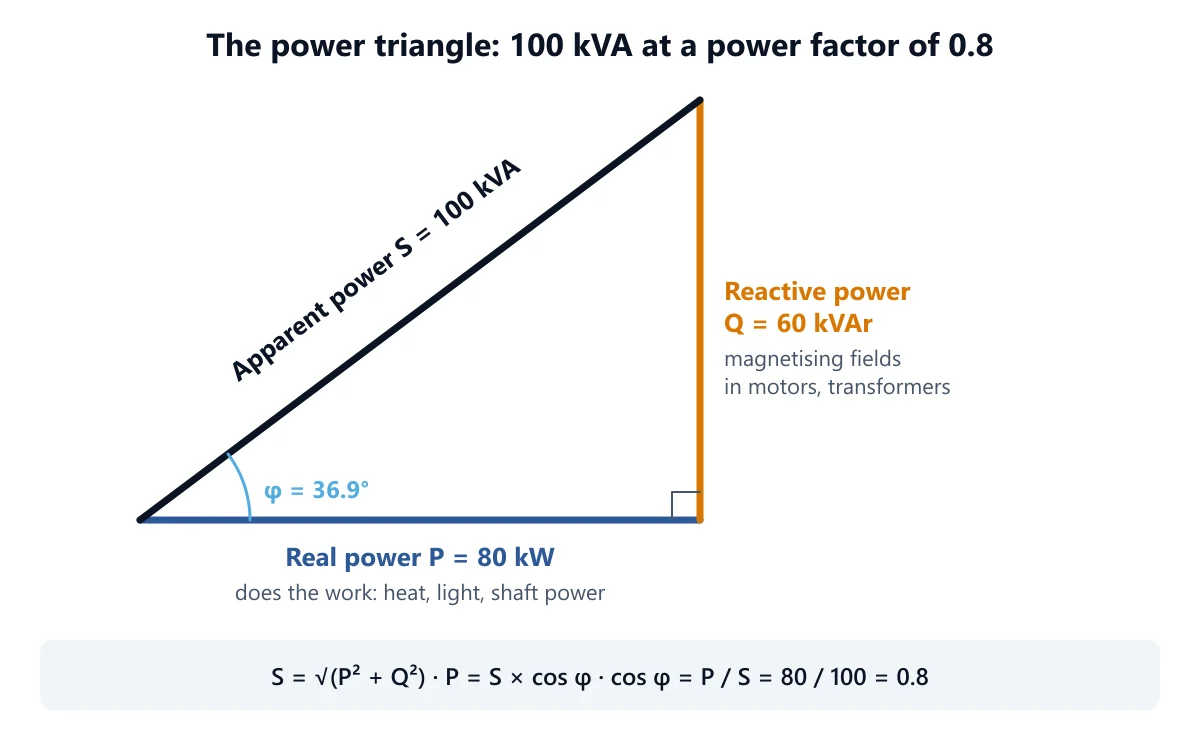
The relationships you need, all from that one triangle:
S = √(P² + Q²)
P = S × cos φ (kVA to kW)
S = P / cos φ (kW to kVA)
Q = √(S² − P²) = S × sin φ
At a power factor of 0.8 the angle is 36.9°, and the sides fall in the familiar 3-4-5 ratio: 100 kVA, 80 kW, 60 kVAr. That is why 0.8 is such a convenient number in examples, and why it turns up as a default in so many ratings.
kVA vs kW: why equipment is rated in kVA
A transformer's windings heat up with the current through them (the copper losses go as I²R), and its core with the voltage across it. Neither depends on the power factor. A 500 kVA transformer at 400 V carries 721.7 A per line at full load, whether the load runs at 0.8 or 0.9.
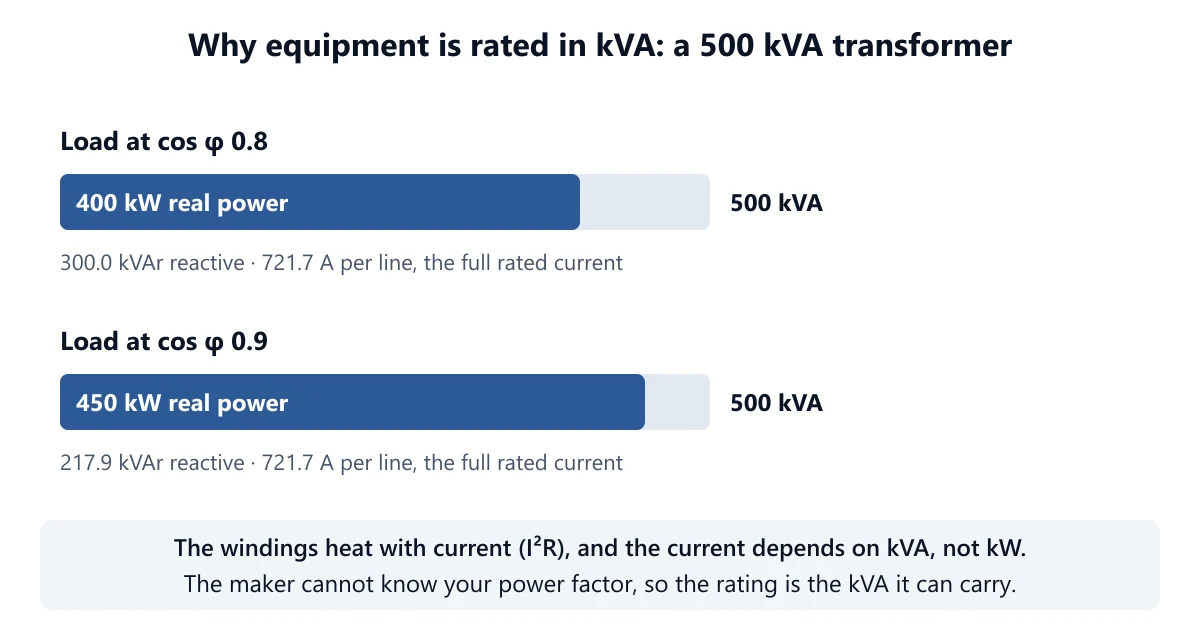
The manufacturer cannot know what power factor you will connect, so the rating is the apparent power it can carry: kVA. The same reasoning applies to:
Generators. The alternator's windings are current-limited, so the alternator is rated in kVA. The engine driving it delivers real power, which is why generator sets quote both a kVA and a kW figure. Sizing one from the running load and the motor starting kVA is what the Generator Sizing Calculator does.
UPSs and inverters. Their power electronics are current-limited too, so they carry a kVA (or VA) rating alongside a kW limit.
Cables and switchgear. These are rated in amps, which is the same thing in a different unit: the current follows the kVA, not the kW.
Loads, on the other hand, are usually described in kW, because kW is what they consume and what the energy bill counts. The design job is to turn the load's kW into the kVA and current the supply has to deliver.
How the power factor changes the kVA
Hold the real power fixed and let the power factor fall, and the kVA and the current climb. The chart shows an 80 kW three-phase load at 400 V.
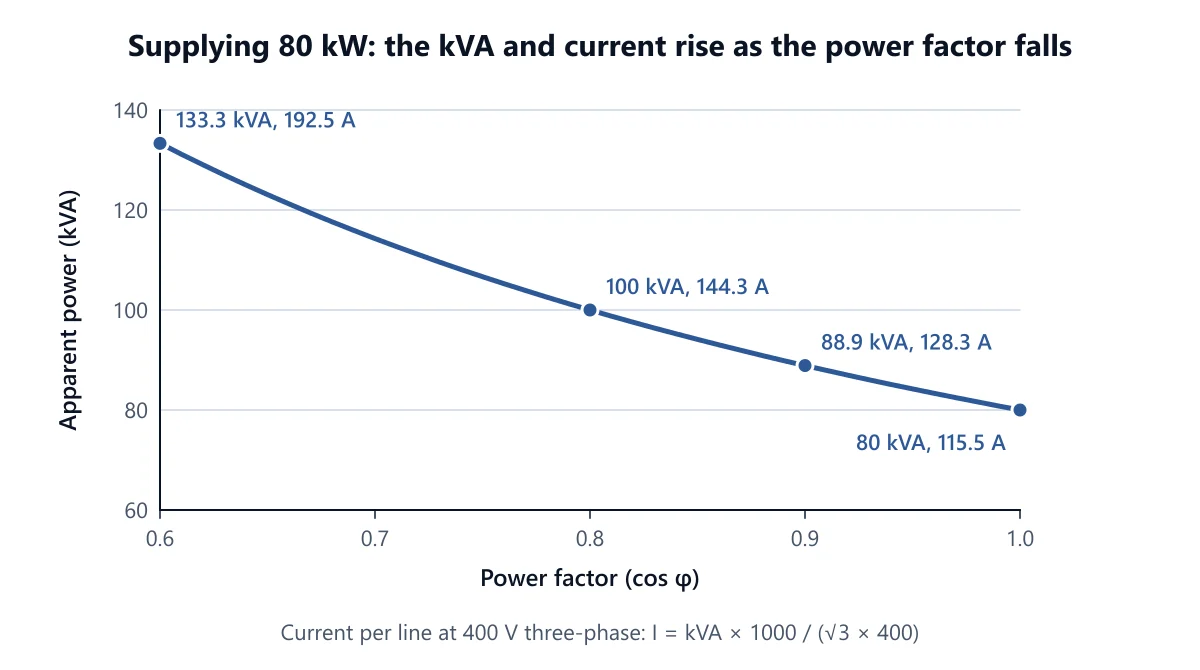
At unity power factor 80 kW needs 80 kVA and 115.5 A per line. At 0.8 it needs 100 kVA and 144.3 A. At 0.6 it needs 133.3 kVA and 192.5 A: two thirds more current, bigger cables and a bigger transformer, for exactly the same useful output.
Worked conversions
Example 1: kVA to kW and amps (a 100 kVA supply)
A 100 kVA three-phase supply at 400 V, with a load power factor of 0.8.
Real power: P = 100 × 0.8 = 80 kW.
Reactive power: Q = √(100² − 80²) = √3600 = 60 kVAr.
Current: I = 100 × 1000 / (√3 × 400) = 100 000 / 692.8 = 144.3 A per line.
Example 2: kW to kVA (a workshop with a poor power factor)
A workshop with 60 kW of mostly motor load measured at a power factor of 0.75, on 400 V three-phase.
Apparent power: S = 60 / 0.75 = 80 kVA.
Reactive power: Q = √(80² − 60²) = 52.92 kVAr.
Current: I = 80 000 / (√3 × 400) = 115.5 A per line.
Raise the same workshop's power factor to 0.95 with a capacitor bank and the numbers become 63.16 kVA, 19.72 kVAr and 91.16 A. The work done is still 60 kW, but the supply carries about 24 A less in each line. Sizing that bank is a job for the Power Factor Correction Calculator.
Example 3: amps to kVA and kW (a measured current)
A clamp meter reads 120 A in each line of a 400 V three-phase submain, and the load's power factor is 0.85.
Apparent power: S = √3 × 400 × 120 / 1000 = 83.14 kVA.
Real power: P = 83.14 × 0.85 = 70.67 kW.
Reactive power: Q = √(83.14² − 70.67²) = 43.80 kVAr.
Example 4: a single-phase UPS
A 5 kVA single-phase UPS at 230 V and a load power factor of 0.8 delivers 4 kW, and at its full 5 kVA it carries 5000 / 230 = 21.74 A. If the connected equipment needs more than 4 kW at that power factor, the UPS is overloaded even though the kVA looks fine on paper.
Example 5: adding loads with different power factors
A small factory switchboard feeds 40 kW of resistive heating (power factor 1.0) and 30 kW of motors at 0.8. It is tempting to add the kVA of each: 40 kVA + 30 / 0.8 = 37.5 kVA, giving 77.5 kVA. That overstates the load, because the two currents are not in step. Add the parts of the triangle instead:
Real power: P = 40 + 30 = 70 kW.
Reactive power: the heaters have none; the motors have 30 × tan(arccos 0.8) = 30 × 0.75 = 22.5 kVAr.
Apparent power: S = √(70² + 22.5²) = 73.53 kVA.
Overall power factor: 70 / 73.53 = 0.952, and the current is 73 530 / 692.8 = 106.1 A per line.
The resistive load improves the overall power factor of the board, which is why a site measurement is often better than the worst individual load. The 4 kVA difference here is small; on a large site with a mix of drives, lighting and heating it decides the transformer size. This is also how the Generator Sizing Calculator combines its running loads: it sums the kW and the kVAr, then takes the square root.
Where kVAr comes from, and where it goes
Reactive power is not wasted energy in the sense that it is burned; it is borrowed and returned every half cycle. But the current that carries it is real, and that current heats every conductor between the source and the load. That is the cost of a poor power factor: larger cables, more voltage drop, transformers and generators that reach their rating sooner, and, on kVA tariffs, a bigger demand charge. Capacitors supply the reactive power locally, close to the motors, so the network upstream carries only the real part.
Common mistakes
Treating a kVA rating as kW. A 100 kVA generator will not run 100 kW of load at 0.8 power factor; it runs 80 kW. Check both limits.
Sizing cables from kW without the power factor. The cable carries the current, which follows the kVA. Using kW / (√3 × V) assumes unity power factor and undersizes motor circuits.
Adding kVA from loads with different power factors. kVA values add as vectors, not numbers. Add the kW and the kVAr separately, then take S = √(P² + Q²).
Using the full-load power factor at light load. Induction motors run at a lower power factor when lightly loaded, so a measured site power factor is often worse than the nameplate.
Forgetting the √3 on three-phase. S = √3 × VL × I, with VL the line-to-line voltage. Using 3 × 400 × I overstates it by 73%.
FAQ
How do I convert kVA to kW?
Multiply by the power factor: kW = kVA × cos φ. 100 kVA at 0.8 is 80 kW; at 0.9 it is 90 kW. Without a known power factor, 0.8 is the usual assumption for mixed and motor loads.
How many kW is a 100 kVA generator?
At a power factor of 0.8, 100 kVA is 80 kW. Generator sets are commonly quoted with a kVA rating and the kW at 0.8 power factor alongside it; the data sheet states which figures apply.
Is kVA bigger than kW?
For the same load, kVA is always equal to or larger than kW, because the power factor is at most 1. They are equal only for purely resistive loads, such as heaters and hot water elements.
Why does my electricity bill mention kVA?
Some Australian network tariffs for larger customers charge demand on kVA rather than kW, so a poor power factor raises the bill even when the energy used is unchanged. The tariff schedule from your network or retailer says how demand is measured.
Convert kVA, kW and amps in the calculator
Open the kVA Calculator, choose what you are converting from (kVA, kW or amps), pick single or three phase, keep 230 V or 400 V or enter your own, and type the power factor (0.8 if unknown). It returns the kVA, kW, kVAr and line current together, with the formula for each. If you started from kW and only need the current, the kW to Amps Calculator does that, and our guide to kW to amps explains the formulas. Take the current from there into the Cable Size Calculator; for heavier commercial loads see how to size cables for commercial and industrial use. Motors have their own guide: motor full load current.
Work it out for your circuit
Free calculators, no sign-up needed.
Related articles
Continue reading more articles on this topic.
Industry KnowledgeAhmed Tayeh
kW to Amps: How to Convert Kilowatts to Amps for Single-Phase, Three-Phase and DC
The kW to amps formulas for single-phase, three-phase and DC supplies, why the p…
Read more: kW to Amps: How to Convert Kilowatts to Amps for Single-Phase, Three-Phase and DC
Industry KnowledgeSuheib
Motor Full Load Current: Converting Motor kW to Amps for Three-Phase Motors
A motor's kW rating is shaft output, not electrical input. Here is how to turn i…
Read more: Motor Full Load Current: Converting Motor kW to Amps for Three-Phase Motors
Industry KnowledgeAhmed Tayeh
Single Line Diagram for Commercial Buildings: A Step-by-Step Guide
A single line diagram is the backbone of every commercial electrical design, sho…
Read more: Single Line Diagram for Commercial Buildings: A Step-by-Step Guide