

Industry KnowledgeBy Ahmed Tayeh
kW to Amps: How to Convert Kilowatts to Amps for Single-Phase, Three-Phase and DC
The kW to amps formulas for single-phase, three-phase and DC supplies, why the power factor matters, and two EV charger examples worked step by step.
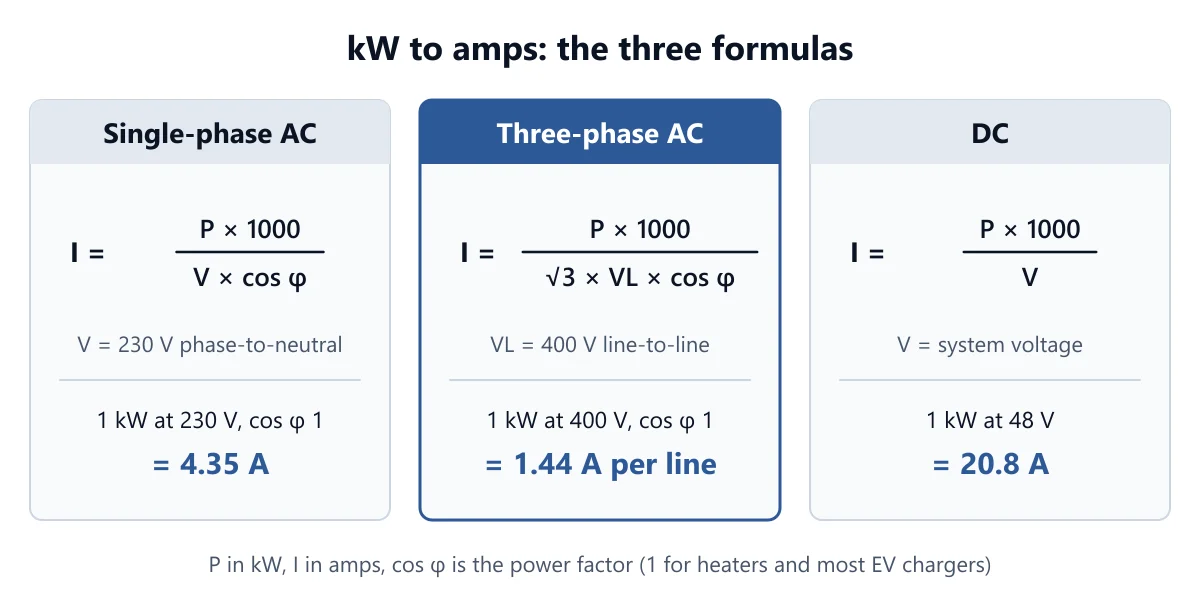
To convert kW to amps, divide the power in watts by the voltage and the power factor: I = P × 1000 / (V × cos φ) for single-phase, and I = P × 1000 / (√3 × V × cos φ) for three-phase, where V is the line-to-line voltage. For DC there is no power factor, so I = P × 1000 / V. On Australian supplies, 1 kW at 230 V and unity power factor is about 4.35 A, and 1 kW at 400 V three-phase is about 1.44 A in each line.
That answers the quick question. The rest of this guide covers which voltage to use, where the √3 comes from, how much the power factor changes the answer, how to go the other way (amps to kW), and two worked examples every electrician meets now: a 7.4 kW single-phase EV charger and a 22 kW three-phase one. The numbers match what the CableHero kW to Amps Calculator shows for the same inputs.
The kW to amps formulas
Every conversion is the same idea: power is voltage times current, with the power factor turning the apparent power that the current carries into the real power that does the work. What changes between systems is which voltage you use and whether the √3 appears.
Single-phase AC
I = P × 1000 / (V × cos φ)
P is the real power in kW, V the phase-to-neutral voltage (230 V nominal in Australia and New Zealand) and cos φ the power factor. A 2.4 kW heater, which is a resistive load with a power factor of 1, draws 2400 / 230 = 10.43 A.
Three-phase AC
I = P × 1000 / (√3 × VL × cos φ)
VL is the line-to-line voltage, 400 V nominal. The answer is the current in each line, and it assumes a balanced load, the same current in all three lines. A 10 kW three-phase load at a power factor of 0.8 draws 10 000 / (1.732 × 400 × 0.8) = 18.04 A per line.
DC
I = P × 1000 / V
DC has no reactive power, so there is no power factor to include. A 5 kW load on a 48 V battery system draws 5000 / 48 = 104.2 A, which is why low-voltage DC systems need large cables for modest power.
Where the √3 comes from
In a balanced three-phase system the voltage between two lines is √3 times the voltage from a line to neutral: 230 × 1.732 = 398 V, which rounds to the 400 V nominal. The total power is three times the power in one phase, P = 3 × Vph × I × cos φ. Replace Vph with VL / √3 and the 3 / √3 becomes √3, giving P = √3 × VL × I × cos φ.
So the three-phase formula is not a different law; it is the single-phase formula applied three times and rewritten in terms of the line voltage you actually measure between phases. If you prefer, you can divide the total power by 3 and use the single-phase formula at 230 V. Both give the same line current within the rounding of 230 versus 400 / √3 = 230.9 V.
Why the power factor matters
The power factor is the ratio of real power (kW) to apparent power (kVA). The current is set by the apparent power, so a load with a poor power factor draws more current for the same kW. A cable, a breaker and a transformer all see that current, not the kW.
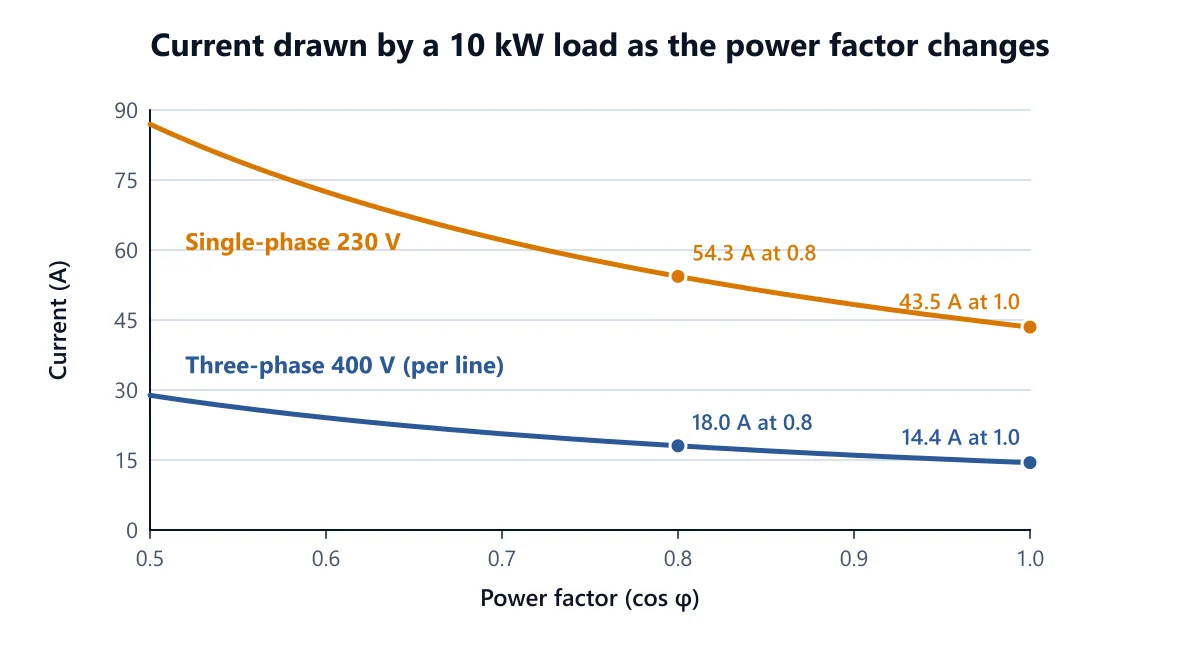
The chart shows a 10 kW load. At unity power factor it draws 43.5 A on single-phase and 14.4 A per line on three-phase. At 0.8 those rise to 54.3 A and 18.0 A, a quarter more current for exactly the same useful power.
Which power factor to use:
Use the nameplate figure when you have it. It is the only number that describes the actual equipment.
Resistive loads such as heaters, hot water elements and ovens are 1.0.
EV chargers and modern electronic loads with power factor correction are close to 1; check the data sheet.
Induction motors run at roughly 0.8 to 0.9 at full load and worse at light load.
0.8 is the usual assumption when nothing better is known, and it is the calculator's default.
Motors need one more step. A motor's kW rating is its shaft output, so the electrical input is the output divided by the efficiency. Feed the input power into the formula, not the nameplate kW, or use the motor full load current method, which includes the efficiency.
Worked example 1: a 7.4 kW single-phase EV charger
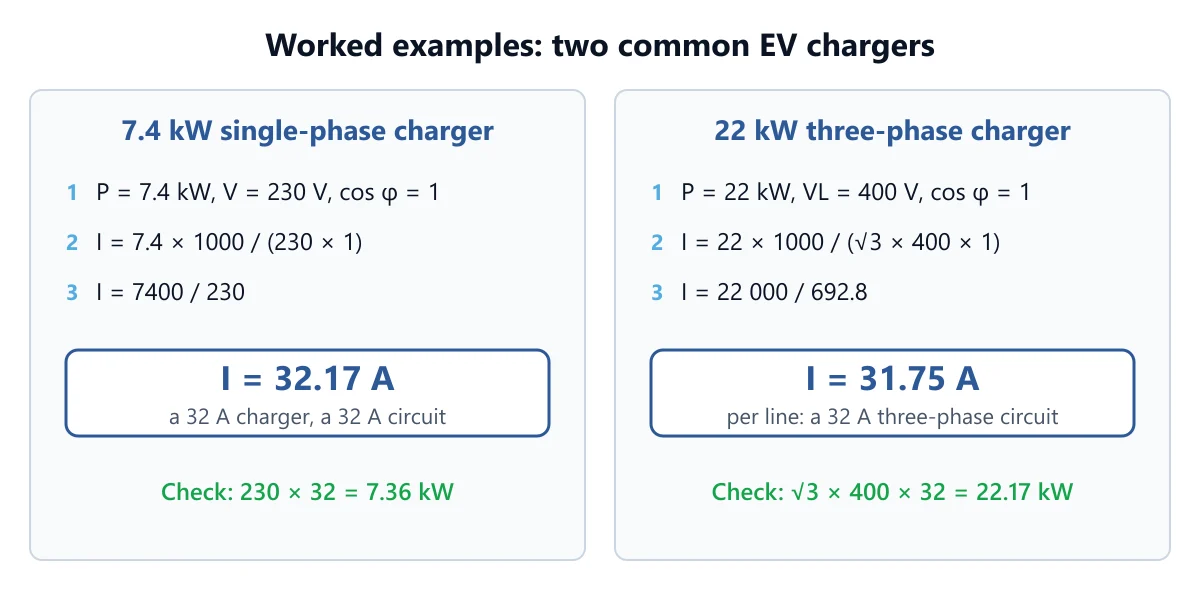
A home EV charger rated 7.4 kW on 230 V single-phase. Chargers like this run at a power factor very close to 1, so we use 1.0.
Write down the inputs: P = 7.4 kW, V = 230 V, cos φ = 1.
Convert to watts: 7.4 × 1000 = 7400 W.
Multiply the voltage by the power factor: 230 × 1 = 230.
Divide: I = 7400 / 230 = 32.17 A.
That is why a "7 kW" charger is really a 32 A device: 32 A × 230 V = 7.36 kW, and the 7.4 kW on the box is a rounded figure. If the data sheet gave a power factor of 0.99 instead, the calculated current would be 32.50 A. In practice, design from the rated input current on the charger's data sheet (32 A for this class), not from the rounded kW on the box.
Worked example 2: a 22 kW three-phase EV charger
A commercial or larger residential charger rated 22 kW on 400 V three-phase, again at a power factor of 1.
Inputs: P = 22 kW, VL = 400 V, cos φ = 1.
Convert to watts: 22 × 1000 = 22 000 W.
Work out the denominator: √3 × 400 × 1 = 1.732 × 400 = 692.8.
Divide: I = 22 000 / 692.8 = 31.75 A per line.
A 22 kW charger is therefore also a 32 A device, just on three phases: √3 × 400 × 32 = 22.17 kW. The same 32 A per line delivers three times the power of the single-phase charger, which is the whole case for three-phase charging.
Going the other way: amps to kW
Rearrange the same formulas when you know the current and want the power, for example to check what a circuit can supply:
Single-phase: P = V × I × cos φ / 1000
Three-phase: P = √3 × VL × I × cos φ / 1000
DC: P = V × I / 1000
Some handy reference points at unity power factor:
16 A at 230 V = 3.68 kW; 16 A three-phase at 400 V = 11.09 kW
32 A at 230 V = 7.36 kW; 32 A three-phase at 400 V = 22.17 kW
63 A at 230 V = 14.49 kW; 63 A three-phase at 400 V = 43.65 kW
Drop the power factor and the kW falls with it: 32 A three-phase at 0.8 is 17.74 kW, even though the current, and the kVA (22.17 kVA), are unchanged. The Amps to kW Calculator does this direction and shows the kVA and kVAr alongside.
From current to cable size
The current you calculate is the load's design current. It is the starting point for the circuit design, not the cable size. From there:
Choose a protective device rated at or above the design current. For the chargers above, take the rated current (32 A) and the protection the manufacturer's installation instructions call for.
Pick a cable whose current-carrying capacity, after derating for the installation method, grouping and ambient temperature, is at least the device rating.
Check the voltage drop over the actual route length, and the fault loop impedance for the device.
The Cable Size Calculator does those three checks to AS/NZS 3008.1.1:2025. If you are sizing single-phase circuits, our guide to single-phase cable sizing walks through the method, and how to calculate voltage drop covers the length check.
Common mistakes
Using 400 V in the single-phase formula. A single-phase load sits between a line and neutral, so it sees 230 V. Using 400 V understates the current by 42%.
Dividing three-phase power by 400 V and forgetting the √3. 22 kW / 400 V gives 55 A, not 31.75 A. The √3 is not optional.
Ignoring the power factor. Assuming 1.0 for a motor or a fluorescent lighting board understates the current that heats the cable.
Using a motor's output kW as input power. Divide by the efficiency first, or take the nameplate full load current.
Applying the balanced formula to an unbalanced load. If single-phase loads are spread unevenly across three phases, work out each phase on its own; the busiest phase sets the cable and breaker.
Treating the current as the breaker or cable size. It is the design current. The device and cable are chosen from it, then checked.
FAQ
How many amps is 1 kW?
At 230 V single-phase and unity power factor, 1 kW is 4.35 A. At 400 V three-phase it is 1.44 A per line at unity power factor, or 1.80 A at a power factor of 0.8. At 48 V DC it is 20.8 A.
How many amps is 10 kW three-phase?
At 400 V and a power factor of 0.8, 10 kW draws 18.04 A per line. At unity power factor it is 14.43 A. On 230 V single-phase the same 10 kW would draw 54.35 A at 0.8, or 43.48 A at 1.0.
Do I use 230 V or 240 V?
The nominal low-voltage supply in Australia is 230/400 V. Older equipment and documents still say 240/415 V, and measured voltages vary across the permitted range. For design, use 230 V and 400 V; using a higher voltage gives a slightly lower current, which is the less conservative answer.
Is kW the same as kVA?
Only at unity power factor. kVA is the apparent power, which the current carries; kW is the real power. kW = kVA × cos φ. A 22 kW load at 0.8 power factor is 27.5 kVA, and it is the kVA that sets the current.
Convert it in the calculator
Open the kW to Amps Calculator, pick Single phase, Three phase or DC, leave the voltage at 230 V or 400 V (or type your own), enter the power factor from the nameplate (1 for an EV charger or heater) and the power in kW. It returns the current with the kVA and kVAr, and the formula it used. Then carry the current into the Cable Size Calculator to choose the cable. For the full set of tools, see our guide to free electrical calculators.
Work it out for your circuit
Free calculators, no sign-up needed.
Related articles
Continue reading more articles on this topic.

Industry KnowledgeSuheib
Motor Full Load Current: Converting Motor kW to Amps for Three-Phase Motors
A motor's kW rating is shaft output, not electrical input. Here is how to turn i…
Read more: Motor Full Load Current: Converting Motor kW to Amps for Three-Phase Motors
Industry KnowledgeAhmed Tayeh
Single Line Diagram for Commercial Buildings: A Step-by-Step Guide
A single line diagram is the backbone of every commercial electrical design, sho…
Read more: Single Line Diagram for Commercial Buildings: A Step-by-Step Guide
Industry KnowledgeAhmed Tayeh
How to Read a Single Line Diagram: A Complete Guide for Electricians and Engineers
Single line diagram (SLD) explained; how to read symbols, trace power flow, iden…
Read more: How to Read a Single Line Diagram: A Complete Guide for Electricians and Engineers