

Industry KnowledgeBy Suheib
Motor Full Load Current: Converting Motor kW to Amps for Three-Phase Motors
A motor's kW rating is shaft output, not electrical input. Here is how to turn it into full load amps with efficiency and power factor, and when to trust the nameplate instead.

A three-phase motor's full load current is its rated output divided by √3, the line voltage, the efficiency and the power factor: I = P × 1000 / (√3 × V × η × cos φ). A 15 kW motor on 400 V with 92% efficiency and a 0.85 power factor draws about 27.7 A at full load. The nameplate value governs once you have the motor; before then, the calculation or the typical currents in IEC 60947-4-1 get you close enough to size the cable and switchgear.
This guide works through the motor full load current formula, why efficiency and power factor both belong in it, how the calculated value compares with the IEC typical table, and two complete examples (15 kW and 37 kW) you can check against the calculator.
Why motor kW is not the electrical load
The kW on a motor nameplate is mechanical power at the shaft. The supply has to deliver that output plus the motor's own losses (copper, iron, friction and windage), and it also has to supply the magnetising current that sets up the field. Two numbers capture this:
Efficiency (η): output divided by electrical input. Electrical input in kW = shaft kW / η.
Power factor (cos φ): real power divided by apparent power. Apparent power in kVA = input kW / cos φ.
Current follows apparent power, not real power. So the chain is always shaft kW → input kW → input kVA → amps. Skip either step and the current comes out low.
The motor full load current formula
For three-phase and single-phase motors:
Three-phase: I = P × 1000 / (√3 × V × η × cos φ)
Single-phase: I = P × 1000 / (V × η × cos φ)
where P is the rated output in kW, V the line-to-line voltage (three-phase) or the terminal voltage (single-phase), η the full load efficiency as a fraction and cos φ the full load power factor. These are the formulas the Schneider Electric Electrical Installation Guide uses for induction motors, and the ones our Motor Full Load Current Calculator runs.
The calculator also reports the input kW, input kVA and input kVAr, because you will need those for power factor correction and generator sizing later.
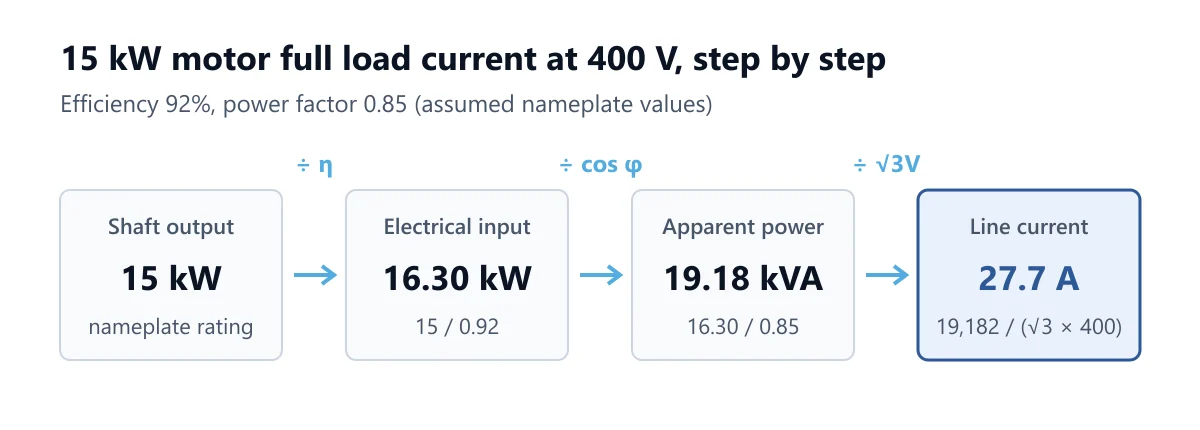
Worked example 1: a 15 kW pump motor at 400 V
A 15 kW, four-pole cage motor driving a pump on a 400 V three-phase supply. Assume a full load efficiency of 92% and a power factor of 0.85, values typical of a modern premium-efficiency motor of this size.
Electrical input: 15 / 0.92 = 16.30 kW
Apparent power: 16.30 / 0.85 = 19.18 kVA
Full load current: 19,182 VA / (√3 × 400 V) = 19,182 / 692.8 = 27.7 A
Reactive power: √(19.18² − 16.30²) = 10.10 kVAr
IEC 60947-4-1 Annex G lists 29 A for a 15 kW motor at 400 V. The 1.3 A gap is the efficiency and power factor: the table covers typical motors across makes, which on average are a little less efficient, or run at a lower power factor, than the ones we assumed.
Worked example 2: a 37 kW fan motor at 400 V
A 37 kW motor on 400 V, efficiency 94% and power factor 0.86:
Electrical input: 37 / 0.94 = 39.36 kW
Apparent power: 39.36 / 0.86 = 45.77 kVA
Full load current: 45,769 / 692.8 = 66.1 A
Reactive power: 23.36 kVAr
Here the calculation and the Annex G value (66 A) agree almost exactly. Larger motors are more efficient and have better power factors, and their spread between makes is narrower, so typical values get more reliable as the rating goes up.
A single-phase check
A 1.5 kW single-phase motor on 230 V with 80% efficiency and a 0.9 power factor: 1.5 / 0.80 = 1.875 kW, / 0.9 = 2.083 kVA, / 230 V = 9.1 A. There is no √3, and small single-phase motors have noticeably lower efficiency, so the amps per kW are far higher than for three-phase machines.
Typical full load currents: IEC 60947-4-1 vs the nameplate
IEC 60947-4-1 (the contactor and motor-starter standard) gives an informative table of rated operational currents for standard three-phase cage motors at 230, 400, 500 and 690 V. Switchgear makers use it to rate contactors and overload relays by kW, and it is the table the calculator shows beside your result. A few values at 400 V:
4 kW: 8.5 A
7.5 kW: 15.5 A
11 kW: 22 A
15 kW: 29 A
22 kW: 41 A
37 kW: 66 A
55 kW: 97 A
75 kW: 132 A
Divide each current by its rating and you get the familiar "2 A per kW" rule of thumb at 400 V. The chart shows where that rule holds and where it does not.
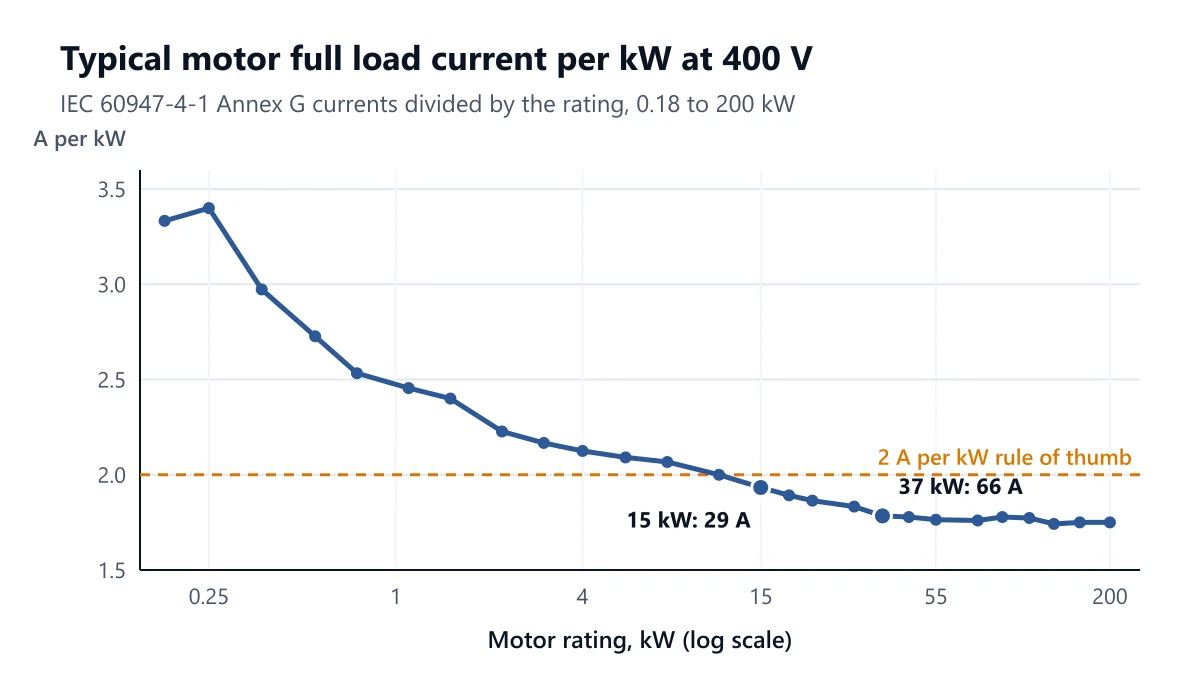
Below about 4 kW, small motors draw well over 2 A per kW because their efficiency and power factor are poor. Above about 30 kW the ratio settles near 1.75 to 1.8 A per kW. The rule of thumb is only right around 10 to 15 kW.
Which number to design with
Concept design, motor not chosen: use the Annex G typical value, or calculate with conservative efficiency and power factor.
Motor selected: use the nameplate or data-sheet full load current. It reflects that motor's real efficiency and power factor.
Overload relay setting: always the nameplate current at the voltage the motor actually runs on.
Older Australian motors are often stamped for 415 V. On a 400 V supply the same output draws roughly 415 / 400 = 1.04 times the stamped current, so allow for that when an old nameplate is all you have.
How much efficiency and power factor change the answer
The same 15 kW motor gives four different currents depending on what you assume:
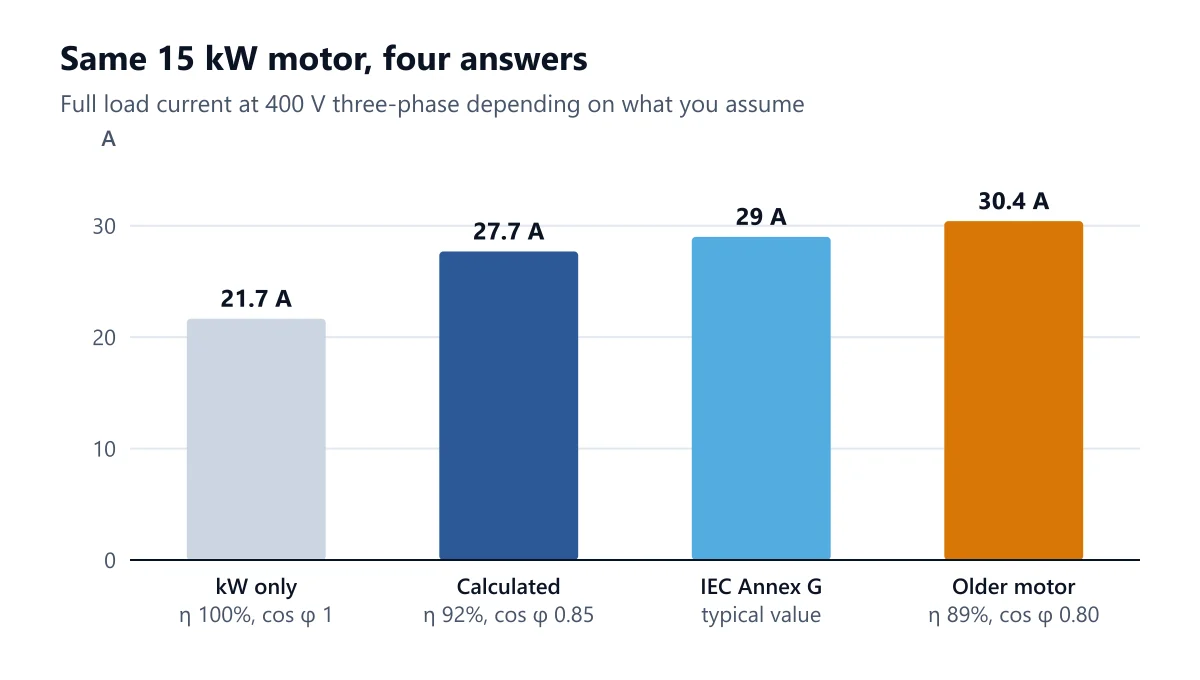
kW only (efficiency and power factor ignored): 15,000 / 692.8 = 21.7 A, about 22% low.
Calculated with η 92% and cos φ 0.85: 27.7 A.
IEC 60947-4-1 typical: 29 A.
Older, less efficient motor with η 89% and cos φ 0.80: 30.4 A.
The "kW only" answer is the trap. It treats shaft output as electrical input and assumes unity power factor, so the cable, overload and circuit breaker all end up undersized.
From full load current to cable and protection
Full load current is the design current (Ib) for the motor circuit. From there:
Cable: size the cable so its derated current-carrying capacity is at least the full load current, then check voltage drop at full load. Our Cable Size Calculator takes the current straight in and applies AS/NZS 3008.1.1:2025 ratings, derating and voltage drop. The commercial and industrial side of that is covered in how to size cables for commercial and industrial use.
Starting: a direct-on-line start draws about 6 to 8 times full load current for a few seconds. The circuit breaker must ride through it (a motor-rated or D-curve device, or a motor protection circuit breaker), and the voltage dip during starting needs its own check. See how to calculate voltage drop for the running case.
Overload: the thermal overload is set to the nameplate full load current, not the circuit breaker rating.
Common mistakes
Treating kW as input power. The rating is output. Divide by efficiency first.
Leaving out power factor. Amps follow kVA. A 0.85 power factor adds 18% to the current.
Using the rule of thumb for small motors. A 0.75 kW motor at 400 V draws 1.9 A, about 2.5 A per kW, not 1.5 A.
Mixing up line and phase voltage. Three-phase formulas use the 400 V line voltage with √3. Using 230 V with √3 overstates the current by √3.
Setting the overload from a calculated value when the nameplate is available. The calculation is for design; the relay protects the actual machine.
Ignoring the supply voltage. A motor stamped 415 V on a 400 V supply, or a 400 V motor on a weak rural supply, draws more current for the same output.
FAQ
How many amps does a 7.5 kW three-phase motor draw?
About 15.5 A at 400 V, the IEC 60947-4-1 typical value. With an assumed 90% efficiency and 0.85 power factor the formula gives 7,500 / (692.8 × 0.90 × 0.85) = 14.2 A. Use the nameplate once the motor is chosen.
Does a motor draw full load current all the time?
No. A motor draws only what the load demands, so a pump throttled back or a lightly loaded conveyor draws less, mostly as magnetising current at a poor power factor. Cables and protection are still sized for full load because the motor can be loaded to its rating at any time.
Is full load current the same as locked-rotor current?
No. Locked-rotor (starting) current is what the motor draws at standstill when switched on direct, typically 6 to 8 times full load current. It sets the starting voltage dip and the protection's ride-through, not the cable's thermal rating.
Why does my motor read lower than the nameplate on a clamp meter?
Usually because it is not fully loaded. A nameplate current is measured at rated output and voltage. Many installed motors run below their rating, because motors are usually chosen with some margin over the driven load.
Calculate it for your motor
Open the Motor Full Load Current Calculator, choose three-phase or single-phase, enter the rated output in kW and the supply voltage, then the efficiency and power factor from the data sheet. It returns the full load current, the input kW, kVA and kVAr, and, for standard ratings at 230, 400, 500 or 690 V, the IEC 60947-4-1 typical current beside it. Take the current into the Cable Size Calculator to size the motor's cable, or browse the rest of the tools in our guide to free electrical calculators.
Work it out for your circuit
Free calculators, no sign-up needed.
Related articles
Continue reading more articles on this topic.

Industry KnowledgeAhmed Tayeh
Single Line Diagram for Commercial Buildings: A Step-by-Step Guide
A single line diagram is the backbone of every commercial electrical design, sho…
Read more: Single Line Diagram for Commercial Buildings: A Step-by-Step Guide
Industry KnowledgeAhmed Tayeh
How to Read a Single Line Diagram: A Complete Guide for Electricians and Engineers
Single line diagram (SLD) explained; how to read symbols, trace power flow, iden…
Read more: How to Read a Single Line Diagram: A Complete Guide for Electricians and Engineers
Industry KnowledgeAhmed Tayeh
Top 10 Cable Sizing Mistakes and How to Avoid Them
Cable sizing looks easy until you look closer. Here are common cable sizing mist…
Read more: Top 10 Cable Sizing Mistakes and How to Avoid Them