
03
Jul
By Ahmed Tayeh · Cable Sizing · 03 July 2026
Understanding the AS/NZS 3000 Wiring Rules
AS/NZS 3000 is the cornerstone of electrical safety in Australia and New Zealand. It governs every electrical installation, from the layout of wiring systems and selection of protective devices to earthing arrangements, maximum demand calculations, and verification testing.
The AS/NZS 3000 Wiring Rules are legally mandatory across all Australian states and territories and in New Zealand when referenced in state or territory electrical safety legislation.
However, knowing the standard exists and knowing how to apply it are two different things. For electrical designers, the sections that matter most in day-to-day practice are not necessarily the ones that get the most attention in training.
This guide covers the key sections and clauses every electrical designer must understand, with the specific requirements, common failure points, and practical design implications for each.
What Is AS/NZS 3000?
The AS/NZS 3000 wiring rules outline the requirements for design, construction, and verification of all electrical installations in Australia and New Zealand.
These rules protect people, property, and equipment from hazards like electric shock, fire, and system failure. They apply to all environments and are relied upon daily by electricians, engineers, inspectors, and manufacturers.
The standard is divided into two parts:
- Part 1 covers scope, application, and fundamental principles
- Part 2 provides guidance on how to comply with Part 1
Throughout 2024, the EL-001 committee conducted an in-depth scoping exercise informed by 500+ items of industry feedback, and is proposing a revision.
Industry reporting indicates EL-001 is aiming to release a draft for public comment in Q3 2026, with the final edition scheduled for mid-2027.
What Are the Eight Sections Within the AS/NZS 3000?
There are eight sections within the AS/NZS 3000 Wiring Rules:
Section 1: Scope, Definitions, and Fundamental Safety Principles
Section 1: Scope, Definitions, and Fundamental Safety Principles
Section 1 establishes the foundation the entire standard is built on. It defines key terms, establishes the scope of the standard, and sets out the fundamental safety principles that all subsequent sections are designed to achieve.
For designers, the most important concept in Section 1 is the distinction between basic protection and fault protection. Every design decision in the standard traces back to satisfying one or both of these protection objectives.
Section 2: General Arrangement, Control, and Protection
Section 2: General Arrangement, Control, and Protection
Section 2 is where most of the day-to-day design decisions are made.
- Maximum Demand (Clause 2.2). The maximum demand calculation determines the size of the main switchboard, consumer mains, and upstream supply.
- RCD Protection (Clause 2.6). RCD requirements have expanded significantly across the editions of AS/NZS 3000. These are required for most socket outlets and all final subcircuits in Class 2 and Class 9 buildings
- Overcurrent Protection (Clause 2.10). Every circuit must be protected against both overload and short-circuit current. The protective device must be rated to interrupt the maximum prospective fault current at its point of installation.
Section 3: Installation of Wiring Systems
Section 3 governs how cables are selected, routed, supported, and protected throughout the installation.
- Cable Selection (Clause 3.5). All cables must be selected for the thermal, mechanical, and environmental conditions of their installation. This means confirming current-carrying capacity in accordance with AS/NZS 3008.
- Voltage Drop (Clause 3.6). The 5% voltage drop limit in Clause 3.6 applies from the point of supply to the furthest point of utilisation. AS/NZS 3000 gives designers flexibility in allocating the voltage drop budget between submains and final circuits.
- Mechanical Protection and Cable Support (Clause 3.8). In areas where cables can’t be easily accessed, cables must be fixed by clipping or tying.
Section 4: Switchgear and Controlgear
Section 4 covers the specification, selection, and installation of switchboards and their components. The key compliance requirement is that main switchboards must be type-tested or design-verified assemblies.
Section 5: Earthing and Bonding
Section 4 covers the specification, selection, and installation of switchboards and their components. The key compliance requirement is that main switchboards must be type-tested or design-verified assemblies.
Section 5: Earthing and Bonding
Section 5 is the most safety-critical section of the Wiring Rules. Earthing failures can cause more fatalities and trigger more enforcement action than any other electrical defect.
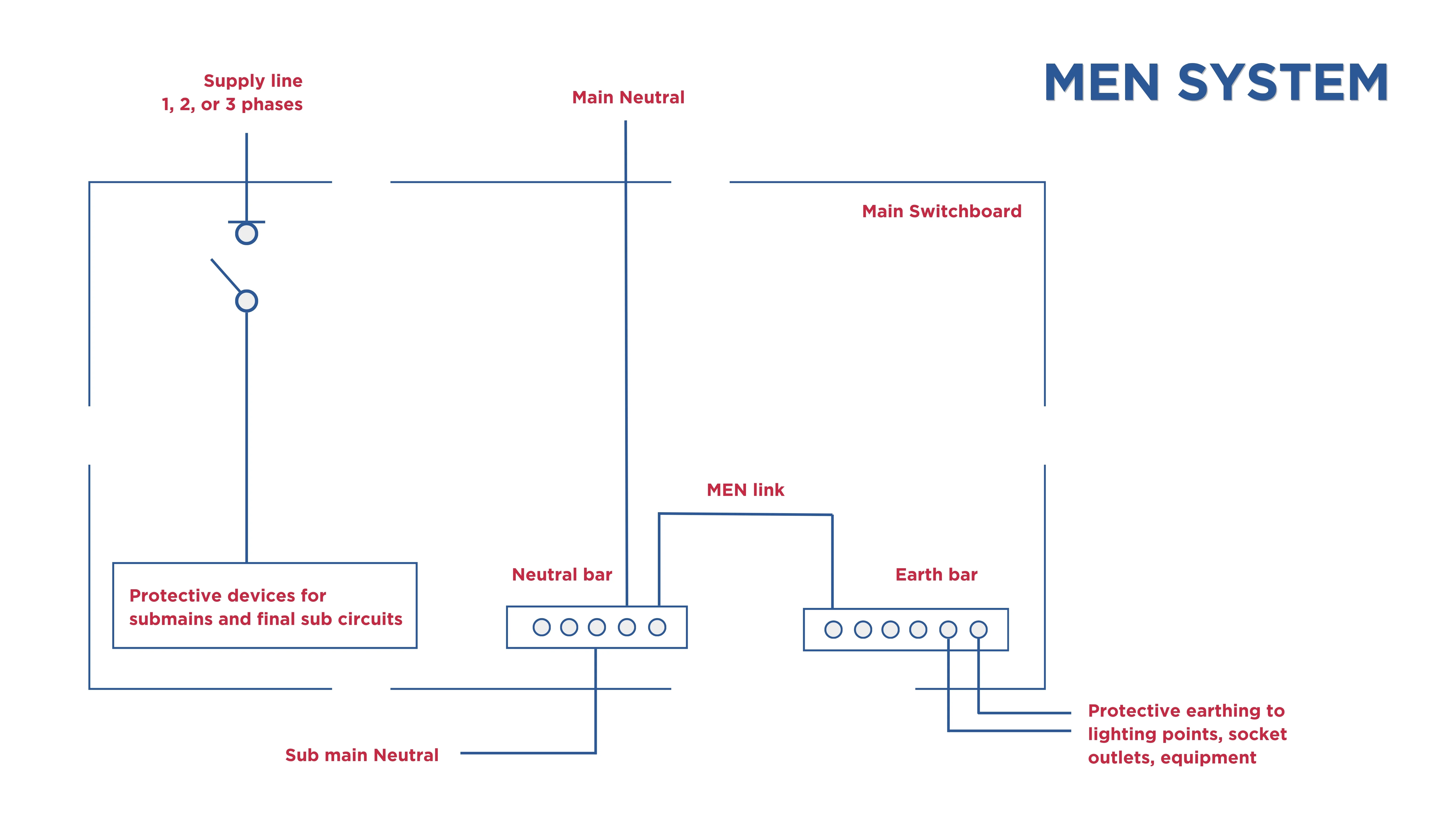
- The MEN System. A Multiple Earthing Neutral (MEN) system is mandatory in Australia and New Zealand. Conductors, electrode sizing, continuity, and bonding must meet strict rules to ensure quick disconnection during faults.
- Minimum Earth Conductor Sizes (Table 5.1). AS/NZS 3000 Table 5.1 specifies the minimum protective earth (PE) conductor size for each active conductor size.
- Equipotential Bonding (Clause 5.6.2.5). All extraneous conductive parts must be bonded to the main earth bar.
Section 6 covers installation types with requirements that go beyond the general rules of Sections 2 through 5, which include:
- Solar PV Systems. AS/NZS 3000 works alongside AS/NZS 4777.1:2025 and AS/NZS 4777.1:2020 Amendment 2:2024 for all inverter-connected solar installations.
- Electric Vehicle Charging. The 2018 edition introduced specific requirements for EV charging equipment and wiring, reflecting the rapid growth in EV adoption.
- Damp and Wet Locations. Specific cable types, IP-related enclosures, and additional RCD protection requirements are all detailed in this section.
- Hazardous Areas. Section 7 covers explosive atmospheres and requires equipment and wiring methods that meet Ex-rated certifications beyond the scope of the general Wiring Rules.
Section 8: Verification by Inspection and Testing
Every completed installation must be verified before it is energised and placed into service. Section 8 defines the mandatory verification process, which includes two components:
- Visual Inspection. Confirms that the correct equipment has been installed, cables are correctly identified and protected, and the installation complies with the wiring rules.
- Testing. Confirms the electrical performance of the installation through a defined sequence of tests.
The mandatory tests under AS/NZS 3000 Section 8 include:
- Continuity of protective earth conductors
- Insulation resistance
- Polarity
- Earth fault loop impedance (EFLI)
- RCD operation (trip time and trip current)
- Prospective fault current
The date of initial energisation is now required to be recorded at the installation switchboard. The Certificate of Compliance or Verification for the installation must also be accomplished.
How Does CableHero Help You Design to the Wiring Rules?
AS/NZS 3000 sets the compliance framework. AS/NZS 3008 provides the cable sizing data. Between these two standards sit the most technically intensive part of every electrical design.
CableHero is a purpose-built cable sizing and electrical design platform, built to support AS/NZS 3000 and AS/NZS 3008 compliance from the ground up.
With CableHero, you can:
- Size cables with full AS/NZS 3008 correction factor automation
- Verify voltage drop for every circuit
- Check short-circuit withstand
- Size neutral and earth conductors
- Calculate maximum demand
For Australian electrical designers who want to produce compliant designs faster, CableHero is the professional tool built for exactly that purpose.
Start your FREE trial at CableHero now. No credit card required.
FAQ
Is AS/NZS 3000 legally mandatory for all electrical installations in Australia?
AS/NZS 3000 is a voluntary standard. However, it becomes legally mandatory in each state and territory when referenced in the applicable electrical safety legislation or regulations.
What is the voltage drop limit in AS/NZS 3000 and how is it calculated?
AS/NZS 3000 Clause 3.6 sets a maximum voltage drop of 5% from the point of supply to any point of utilisation within the consumer’s installation. This applies to the total cumulative voltage drop across all cable sections in series from the main switchboard to the load.
When is the next edition of AS/NZS 3000 expected and what will change?
Industry reporting indicates EL-001 is aiming to release a draft for public comment in Q3 2026 and deliver the next final edition by mid-2027. This revision is expected to address EV charging requirements, solar PV and battery storage integration, updates to RCD requirements, and alignment with updated referenced standards including AS/NZS 3008:2025.
Tags:cable-sizingas-nzs-3000as-nzs-3008complianceelectrical-industrybest-practicestips
Related Articles
Continue reading more articles on this topic.
 Cable Sizing
Ahmed Tayeh 08 Oct 2026
How to Calculate Residential Maximum Demand for New Home Connections
Getting a new home connected to the grid starts with one number: maximum demand.…
Read More → Cable Sizing
Ahmed Tayeh 02 Oct 2026
How Ambient Temperature Influences Cable Sizing in Australia
Master ambient temperature cable sizing under AS/NZS 3008.1.1:2025; Ka formula, …
Read More → Cable Sizing
Ahmed Tayeh 23 Sept 2026
Voltage Drop Limits in Australia: What AS/NZS 3000 Actually Requires
The 5% voltage drop rule gets quoted constantly in Australian electrical design,…
Read More →