Underground Cable Sizing in Australia: Installation Methods and Derating Explained
18Aug
Ahmed Tayeh
Cable Sizing
Underground Cable Sizing in Australia: Installation Methods and Derating Explained
Underground cable sizing in Australia is consistently more complex than in-air cable selection because buried cables operate in a thermal environment the designer cannot control.
Temperature of the soil
Moisture content
Soil composition
Depth of burial
These factors directly affect how well heat dissipates from the cable and therefore how much current it can safely carry.
Get the correction factors wrong, and the cable runs hotter than designed, degrading insulation and shortening service life. Underestimate soil thermal resistivity on a dry, sandy inland site, and the cable may operate well above its rated temperature during a hot summer.
This guide covers both underground installation methods, all four correction factors that apply to buried cables under AS/NZS 3008.1.1:2025, worked examples, and the key changes in the 2025 edition that affect underground cable sizing in Australia.
What are the Two Underground Installation Methods in AS/NZS 3008?
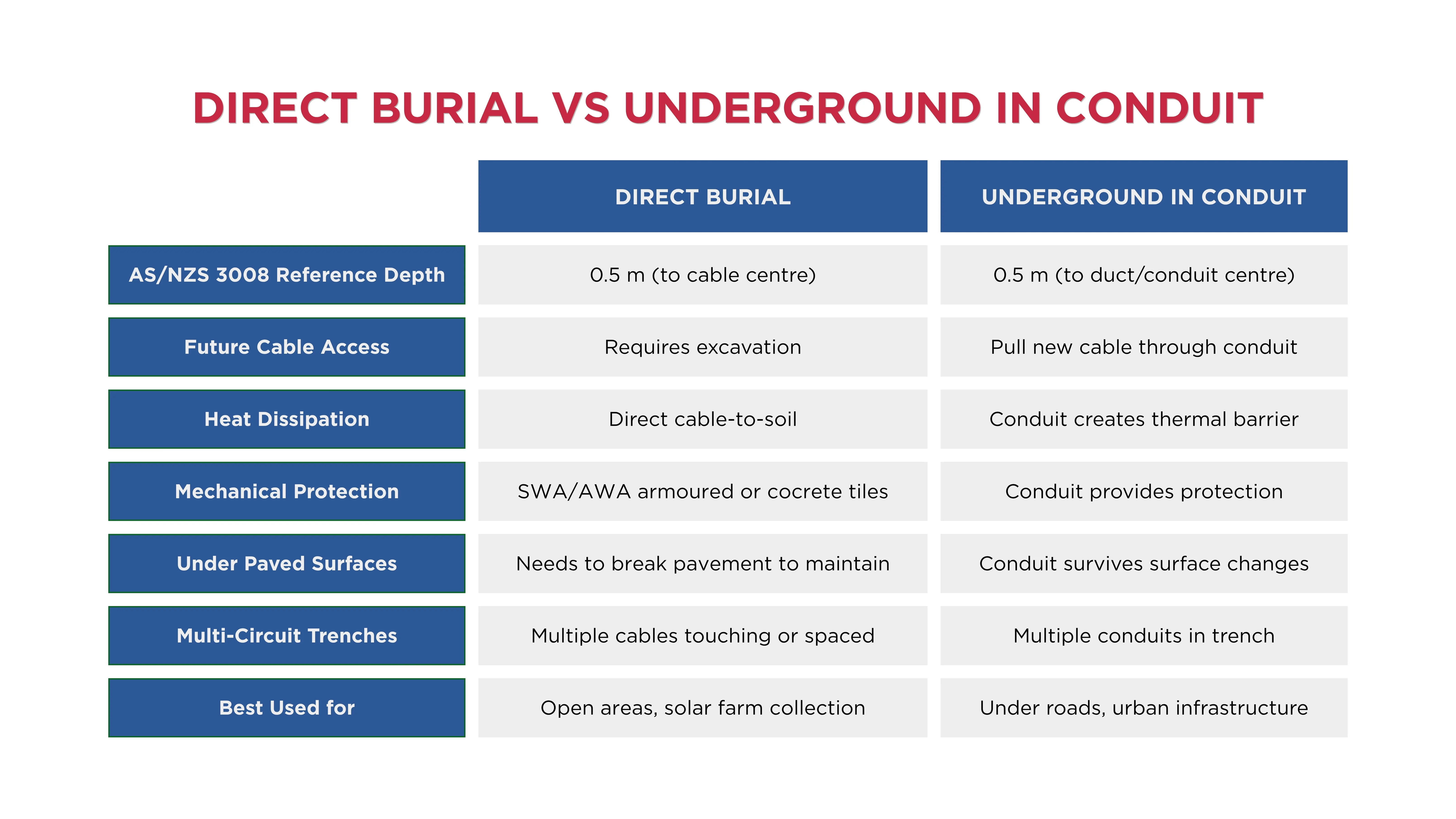
The AS/NZS 3008 Standard outlines the installation and operating conditions for two types of underground cabling: cables buried directly in the ground and cables installed within underground wiring enclosures.
Understanding which method applies to your installation is the first step because the base current ratings, the applicable tables, and the correction factor values differ between the two. C12.2.webp307.55 KB
Method 1: Direct Burial
Direct burial means the cable is placed in a trench and backfilled, with the cable in direct contact with the soil. This gives the most efficient heat transfer path from the cable to the surrounding earth, producing the highest base current ratings for underground installation.
The standard assumes a 0.5 m depth of laying measured from the ground surface to the centre of a cable, or to the centre of a trefoil arrangement of cables for three-phase systems, and a 1.2°C·m/W soil thermal resistivity as the reference conditions for direct burial.
Direct burial is commonly used for:
LV service mains from the point of attachment to the consumer switchboard
MV feeders in substations and utility-scale energy projects
Solar farm DC string cable runs where cables are installed in cable trenches
Rural distribution lines where conduit installation is impractical
For direct burial, AS/NZS 3008 requires the cable to have appropriate mechanical protection. Armoured cables are typically used for direct burial, providing mechanical protection against accidental damage during subsequent excavation. Unarmoured cables buried directly must have supplementary mechanical protection, such as concrete cover tiles or cable markers.
Method 2: Underground in Conduit or Duct
The second method covers cables installed within an underground conduit or duct, which is then buried. The conduit or duct provides mechanical protection but reduces heat dissipation by adding a thermal barrier between the cable and the soil.
Base current ratings for cables in buried conduit are lower than for direct burial — because the conduit reduces the rate of heat transfer from the cable to the surrounding soil. A cable that can carry 150 A when buried directly may only carry 130 A when installed in a conduit at the same depth and soil conditions.
Underground in conduit is commonly used for:
Service connections under paved areas (driveways, roads, footpaths) where future excavation may damage a direct-buried cable
Industrial facilities where cable flexibility and maintainability are priorities
Urban infrastructure where cable replacement must be possible without excavation
Multiple circuits sharing the same trench where separation is required for maintenance purposes
What Are the Four Correction Factors for Underground Cable Sizing?
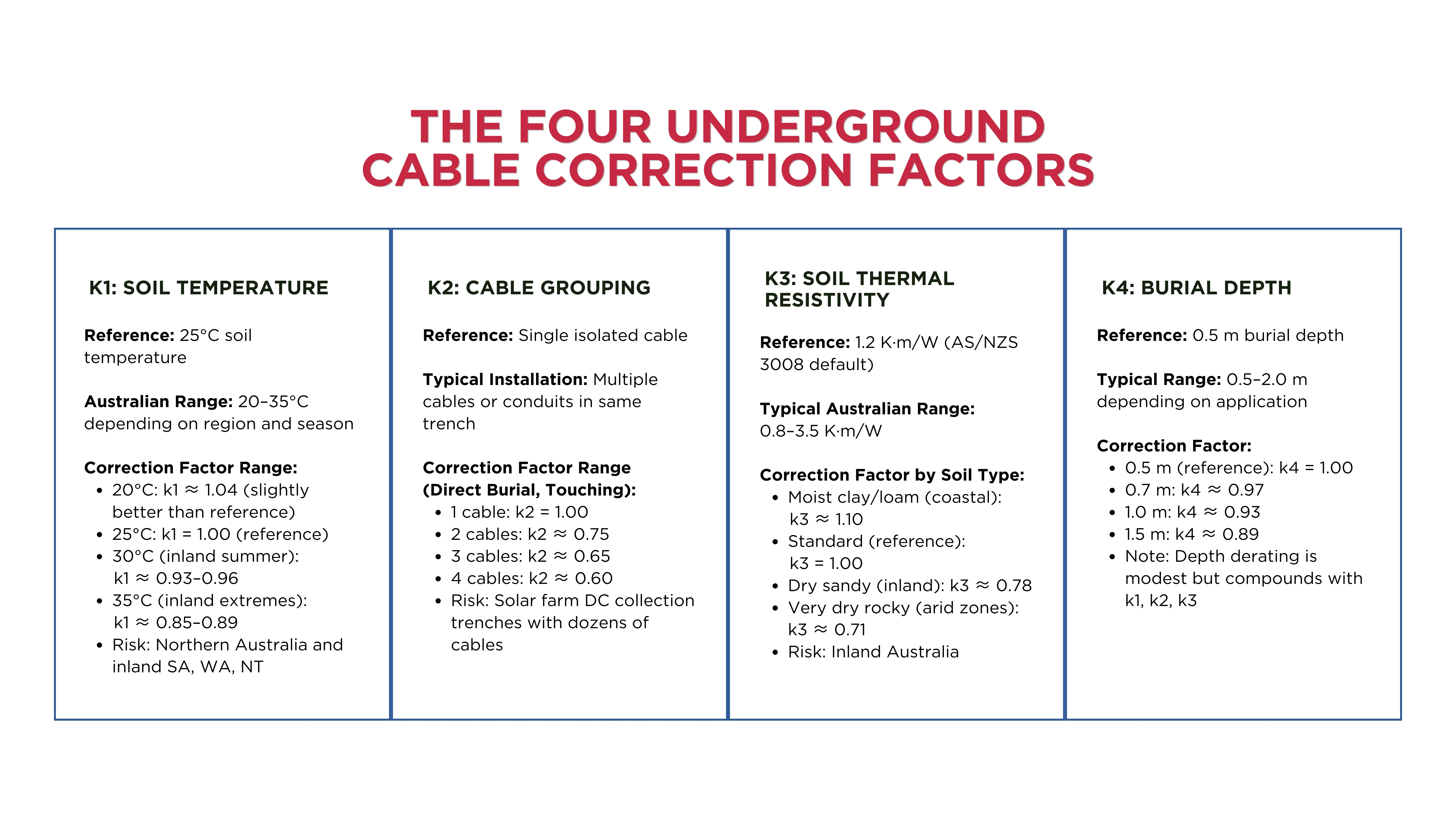
AS/NZS 3008.1.1 applies four correction factors automatically from correction factor tables. All four apply to underground cables. They are multiplicative — meaning all applicable factors must be multiplied together to determine the total derated current capacity.
Iz = Ir × k1 × k2 × k3 × k4
Where Ir is the base current rating from the AS/NZS 3008 table for the applicable underground installation method. C12.3.webp420.56 KB
k1: Soil Temperature Correction
Reference is 40°C for in-air installations and 25°C for buried. Hotter conditions reduce capacity.
The standard base current ratings for underground cables assume a soil temperature of 25°C. In reality, Australian soil temperatures vary by region and season.
In northern Queensland and the Northern Territory, summer soil temperatures at 0.5 m depth commonly exceed 30°C.
On exposed, sun-baked sites in inland NSW and SA, shallow burial depths can experience soil temperatures of 30–35°C in summer.
For PVC-insulated cables, the temperature correction factor at 30°C soil temperature is approximately 0.93, reducing the cable's effective current capacity by 7%. At 35°C, the factor drops to approximately 0.85—a 15% reduction.
For XLPE-insulated cables, the correction factors are less severe because the higher rated temperature provides greater headroom above the elevated soil temperature. The correction is not zero — any deviation from the 25°C reference requires a correction factor below 1.0.
k2: Grouping Correction
When multiple cables are buried in the same trench, they generate collective heat that each cable cannot dissipate as efficiently as when installed in isolation.
The grouping correction factor for underground cables depends on:
The number of cables or circuits in the trench
The spacing between cables (touching or with defined separation)
Whether the cables are in conduit or direct buried
Grouping factors for cables on perforated trays and in enclosed trenches were updated based on thermal imaging studies of real installations. The changes in AS/NZS 3008.1.1:2025 generally result in slightly less conservative factors for well-ventilated installations and slightly more conservative factors for cables in enclosed trenches where ventilation is restricted.
For direct buried cables touching in a horizontal flat formation:
2 cables: approximately 0.75
3 cables: approximately 0.65
4 cables: approximately 0.60
6 cables: approximately 0.54
For cables buried with a clear separation of one cable diameter between each, the grouping factors are less severe, typically 10–15% higher than for touching cables.
On large solar farm projects where dozens of DC string cables share a single cable trench, the grouping correction factor is often the dominant derating factor. Failure to apply it correctly produces cables that are materially undersized for their actual thermal environment.
k3: Soil Thermal Resistivity Correction
Soil thermal resistivity is the measure of how effectively heat moves through soil away from the cable. It is measured in K·m/W (kelvin-metres per watt). Lower values indicate better heat transfer; higher values indicate poor heat dissipation and greater derating required.
The AS/NZS reference of 1.2 K·m/W is notably less conservative than BS 7671 and IEC 60364's value of 2.5 K·m/W, reflecting generally better soil conditions in populated Australian areas. However, in dry inland regions, AS/NZS requires significant derating.
Typical Australian soil thermal resistivity values:
Moist, compacted clay or loam: 0.8–1.0 K·m/W; Better than the standard reference; no additional derating required for standard calculations
Standard mixed soil (AS/NZS reference): 1.2 K·m/W; The base assumption; no correction factor applied
Dry sandy soil: 2.0–3.0 K·m/W; common inland and requires significant derating
Dry limestone or rocky soils: 2.5–3.5 K·m/W; highest resistivity; most severe derating
The k3 correction factor from AS/NZS 3008 at 2.0 K·m/W is approximately 0.89, reducing cable capacity by 11%. At 3.0 K·m/W, the factor drops to approximately 0.75—a 25% reduction from the standard rating.
k4: Depth of Burial Correction
Cables buried at deeper depths dissipate heat less efficiently and therefore need to be derated. The standard reference burial depth for low voltage cables under AS/NZS 3008 is 0.5 metres.
The depth correction factor from AS/NZS 3008 accounts for the reduced heat dissipation efficiency of cables buried deeper than the 0.5 m reference. Typical correction factors:
0.5 m (reference): k4 = 1.00
0.7 m: k4 ≈ 0.97
1.0 m: k4 ≈ 0.93
1.5 m: k4 ≈ 0.89
2.0 m: k4 ≈ 0.86
Depth of burial derating is relatively modest compared to temperature and grouping derating.
For cables buried significantly deeper than the reference, the depth factor compounds with the other correction factors and must be applied.
For shallower burial, the depth factor is advantageous: cables buried at less than 0.5 m have a k4 above 1.0 in the 2025 edition tables.
Underground Cable Sizing: Step-by-Step Worked Example
Single-phase 240 V circuit, 30 A design current, cable buried directly in sandy inland soil, 0.7 m depth, two cables in the same trench touching, soil temperature 30°C. XLPE insulated, 10 mm² copper cable.
Step 1 — Select the Base Current Rating: AS/NZS 3008.1.1:2025; Direct burial, XLPE single-phase cable, 10 mm² copper: Base rating Ir = 95 A
Step 2 — Apply k1 (soil temperature 30°C, XLPE): k1 = 0.96 (from AS/NZS 3008 temperature correction table for 30°C, XLPE 90°C rated)
Total derating: Iz = 95 × 0.96 × 0.75 × 0.78 × 0.97 = 51.7 A
Iz (51.7 A) ≥ Ib (30 A) ✓ — The 10 mm² cable passes current-carrying capacity in these conditions.
Step 6 — Voltage drop check: For a 60 m run at 30 A single-phase: Vd = 2 × 30 × 60 × Rc ÷ 1000
From AS/NZS 3008: Rc for 10 mm² Cu at 75°C ≈ 2.2 Ω/km
Vd = 2 × 30 × 60 × 2.2 ÷ 1000 = 7.9 V = 3.3% — within the 5% limit ✓
Result: 10 mm² XLPE copper cable — passes both checks
What Changed in AS/NZS 3008.1.1:2025 for Underground Cable Sizing?
AS/NZS 3008.1.1:2025 includes several updates relevant to underground cable sizing:
New Soil Thermal Resistivity National Map. An informative annex provides typical soil thermal resistivity zones across Australia and New Zealand. This directly reduces the risk of using an inappropriate reference value when site measurements are unavailable.
Updated Grouping Correction Factors. Factors for cables in enclosed trenches have been made slightly more conservative, reflecting thermal imaging studies that showed enclosed trench environments retain more heat than previously assumed.
Expanded Soil Type Data. The range of tabulated soil types has been expanded, with more granular data for Australian soil conditions and new guidance for seasonally variable soils. Where seasonal variation is significant, the summer (dry) condition governs the cable sizing.
LSZH Cable Type Added. Low-smoke zero-halogen (LSZH) cables now have dedicated current rating rows. Previously, engineers had to use the V-90 (PVC) rows as a proxy, which slightly overstated the current capacity of LSZH cables under some conditions.
Size Underground Cables Correctly with CableHero
Underground cable sizing under AS/NZS 3008.1.1:2025 is one of the most complex cable sizing scenarios in Australian electrical design.
It's important to assess the thermal resistivity along the proposed cable route. The measured values should then be used with the rating factors in the AS/NZS 3008 Standard to ensure accurate cable sizing and safe long-term operation.
CableHero is a cable sizing platform built specifically for AS/NZS 3008.1.1:2025 and AS/NZS 3000 compliance. It handles underground cable sizing in full, all four correction factors (k1 through k4) applied automatically from your inputs, voltage drop calculation for buried cable runs, and short-circuit withstand verification.
For Australian electricians and engineers sizing underground cables, CableHero delivers the correct result under the 2025 standard, automatically.
What are the two underground cable installation methods in AS/NZS 3008 and how do they differ?
AS/NZS 3008 outlines two types of underground cabling: cables buried directly in the ground and cables installed within underground wiring enclosures (conduit or duct). For both methods, the standard reference conditions are 0.5 m burial depth (measured to the centre of the cable) and 1.2°C·m/W soil thermal resistivity. The key difference is thermal performance: cables buried directly in soil have more efficient heat transfer from cable to soil, producing higher base current ratings than cables in conduit.
What is soil thermal resistivity and how does it affect underground cable sizing in Australia?
Soil thermal resistivity influences the current-carrying capacity of cables installed in underground wiring enclosures and direct burial. AS/NZS 3008 adopts a default value of 1.2°C·m/W. In practice, thermal resistivity can vary widely due to soil composition, moisture content, ambient temperature, and installation depth.
What changed for underground cable sizing in AS/NZS 3008.1.1:2025?
The 2025 edition of AS/NZS 3008.1.1 includes several updates relevant to underground cable sizing in Australia. The most significant change for buried cable design is the addition of an informative annex with a national map of typical soil thermal resistivity zones across Australia and New Zealand.


 Cable Sizing