

Industry KnowledgeBy Ahmed Tayeh
Three Phase Power Calculation: Star, Delta, Line and Phase Values with Worked Examples
The one formula behind every balanced three-phase load, what changes between star and delta, and how to handle an unbalanced load phase by phase, with worked numbers at 400 V.

A three phase power calculation for a balanced load uses one formula: P = √3 × VL × IL × cos φ, where VL is the line-to-line voltage (400 V in Australia), IL the current in each line and cos φ the power factor. The apparent power is S = √3 × VL × IL and the reactive power Q = √3 × VL × IL × sin φ. A load drawing 50 A per line at 400 V and a power factor of 0.85 takes 29.44 kW, 18.25 kVAr and 34.64 kVA.
The formula is the same whether the load is connected in star or delta; what changes is the voltage across and the current through each element. This guide explains line and phase quantities, works through a balanced example in both connections, and then shows how to calculate an unbalanced load properly, phase by phase. The balanced figures match the CableHero Three Phase Power Calculator.
Line and phase quantities
Four quantities describe a three-phase circuit, and most errors come from mixing them up:
Line voltage, VL: between any two lines. 400 V nominal.
Phase voltage, Vph: across one element of the load (one winding, one heating element).
Line current, IL: in each supply conductor. This is what a clamp meter on the cable reads, and what the cable and breaker carry.
Phase current, Iph: through one element of the load.
How they relate depends on how the load is connected.
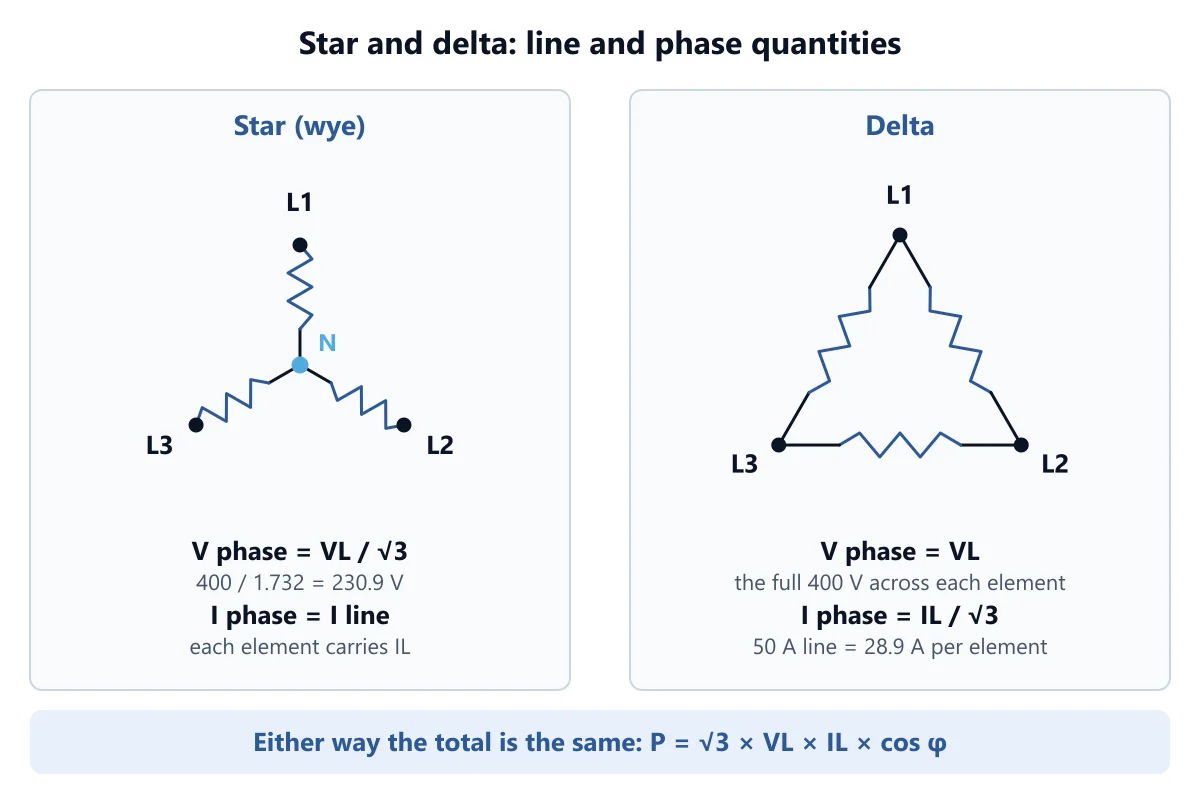
Star (wye)
Each element sits between a line and the star point. Its voltage is the line voltage divided by √3, 400 / 1.732 = 230.9 V, and its current is the line current. If the star point is connected to the supply neutral, single-phase 230 V loads can share the same supply, which is how almost every Australian distribution board works.
Delta
Each element sits directly between two lines, so it sees the full 400 V. The current in each line is the phasor difference of two element currents, so the element current is the line current divided by √3. A delta load has no neutral connection.
Where the √3 comes from
The total power of a balanced load is three times the power of one element: P = 3 × Vph × Iph × cos φ.
In star, Vph = VL / √3 and Iph = IL, so P = 3 × (VL / √3) × IL × cos φ = √3 × VL × IL × cos φ.
In delta, Vph = VL and Iph = IL / √3, so P = 3 × VL × (IL / √3) × cos φ = √3 × VL × IL × cos φ.
The two connections end up with the same expression in line quantities. That is why the calculator asks for the connection only to show the per-element voltage and current; the totals do not depend on it. It is also why you never need to know how a motor is connected internally to work out its power from the line current.
A balanced three phase power calculation, worked
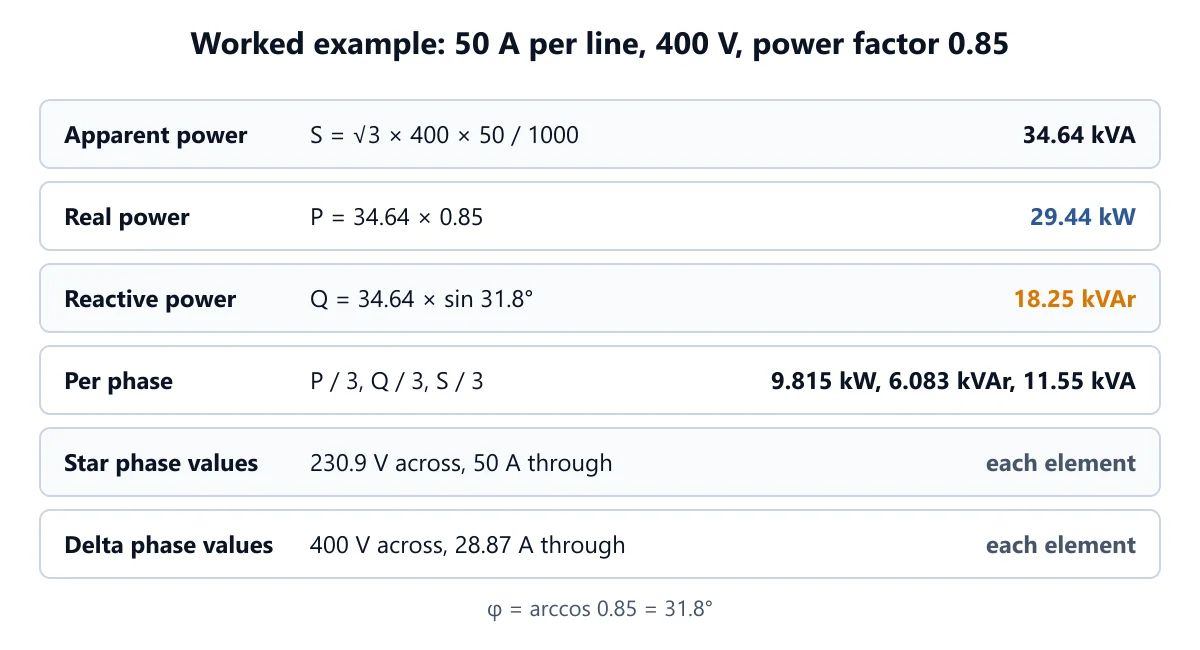
A three-phase load measured at 50 A in each line, on a 400 V supply, with a power factor of 0.85.
Apparent power: S = √3 × 400 × 50 / 1000 = 692.8 × 50 / 1000 = 34.64 kVA.
Phase angle: φ = arccos 0.85 = 31.8°.
Real power: P = 34.64 × 0.85 = 29.44 kW.
Reactive power: Q = 34.64 × sin 31.8° = 18.25 kVAr.
Per phase: each third of the load takes 9.815 kW, 6.083 kVAr and 11.55 kVA.
If it is star-connected: each element has 230.9 V across it and carries 50 A.
If it is delta-connected: each element has 400 V across it and carries 50 / 1.732 = 28.87 A.
A second check, delta this time: a delta-connected motor draws 40 A per line at a power factor of 0.9. P = √3 × 400 × 40 × 0.9 / 1000 = 24.94 kW, Q = 12.08 kVAr, S = 27.71 kVA, and each winding carries 40 / √3 = 23.09 A.
Going the other way: power to current
Rearranged, the same formula gives the line current from the power: IL = P × 1000 / (√3 × VL × cos φ). That is the job of the kW to Amps Calculator, and our guide to kW to amps covers it in detail, including single-phase and DC.
Unbalanced loads: calculate each phase
The √3 formula assumes the three line currents are equal and the power factors are the same. A distribution board feeding single-phase lights, socket-outlets, appliances and the odd three-phase motor is rarely like that. For an unbalanced star-connected load with a neutral, work out each phase on its own and add them:
P = Σ Vph × Iph × cos φph and Q = Σ Vph × Iph × sin φph, then S = √(P² + Q²).
Example: a board measured at 40 A on L1 (power factor 0.90), 32 A on L2 (0.85) and 25 A on L3 (1.00), at 230 V phase-to-neutral.
L1: P = 230 × 40 × 0.90 = 8.28 kW; Q = 230 × 40 × 0.436 = 4.01 kVAr.
L2: P = 230 × 32 × 0.85 = 6.26 kW; Q = 230 × 32 × 0.527 = 3.88 kVAr.
L3: P = 230 × 25 × 1.00 = 5.75 kW; Q = 0.
Totals: P = 20.29 kW, Q = 7.89 kVAr, S = √(20.29² + 7.89²) = 21.77 kVA.
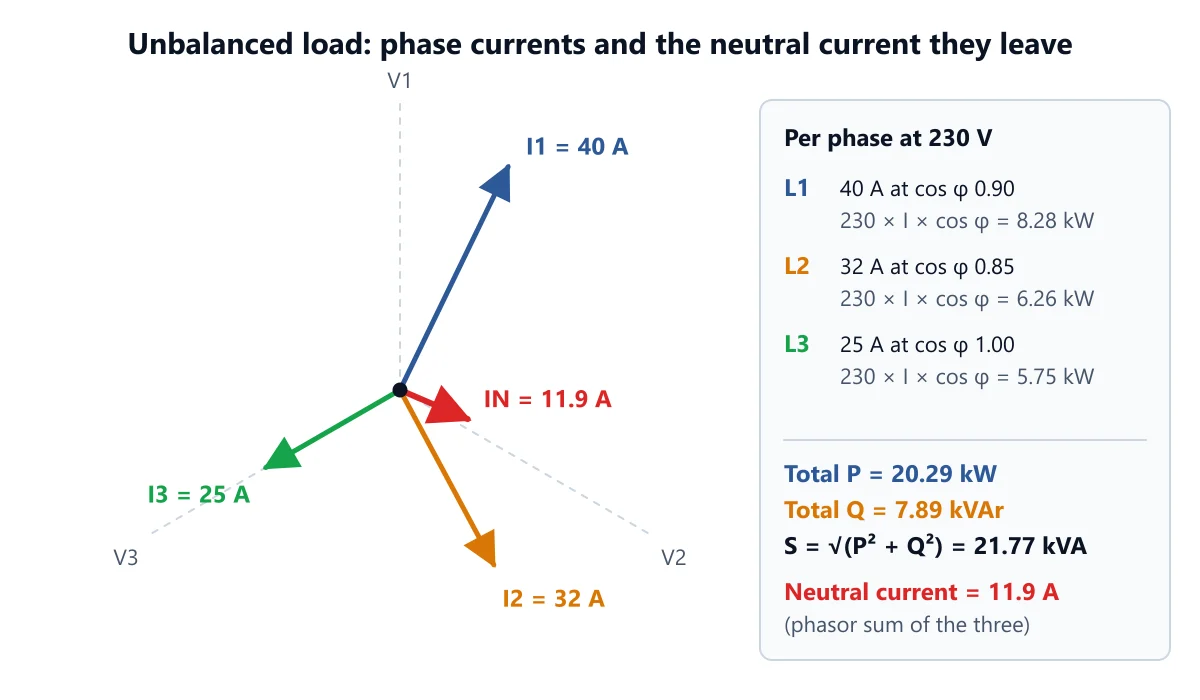
Two things the per-phase method shows that the balanced formula hides. First, the busiest phase, L1 at 40 A, is what sizes the cable and the breaker, not the average. Second, the currents no longer cancel at the star point, so the neutral carries current: the phasor sum of the three, 11.9 A in this example. Plugging the 40 A into the balanced formula at 0.9 would give 24.94 kW, 23% more than the load actually takes, and it would say nothing about the neutral.
The CableHero calculator handles balanced loads and says so on the result. For an unbalanced board, run each phase as a single-phase calculation (the kVA Calculator on single phase does it from the current and power factor) and add the kW and kVAr. Keeping the phases close to equal in the first place is the better fix, and the subject of a later guide on load balancing.
Why the neutral current matters
In a perfectly balanced star load the three line currents are 120° apart and add to zero at the star point, which is why a balanced three-phase motor needs no neutral at all. As soon as the phases differ, the remainder returns on the neutral. If one phase carried 30 A and the other two nothing, the neutral would carry the full 30 A. A multicore cable with a reduced neutral, or a neutral shared between circuits, has to be checked against the worst out-of-balance current it will see, not the balanced case. That out-of-balance current also adds voltage drop on the neutral, so the lightly loaded phases see a higher voltage and the heavily loaded one a lower voltage than the line currents alone would suggest.
Measuring three-phase power on site
Measure all three line currents, not one. If they differ by more than a few amps, use the per-phase method.
Use the measured voltage for diagnostics, but the nominal 230/400 V for design.
Get the power factor from a power meter or the equipment data. A clamp meter's amps alone give you kVA, not kW.
Motors at light load run at a much lower power factor than the nameplate, so the kW from a light-load reading is lower than the current suggests. For full-load design use the nameplate current, as our guide to motor full load current explains.
Common mistakes
Using 3 instead of √3 with the line voltage. 3 × 400 × 50 = 60 kVA, not 34.64 kVA. The 3 belongs with the phase voltage (3 × 230.9 × 50); the √3 with the line voltage.
Using 230 V with the √3. √3 × 230 × 50 understates the power by the same factor of √3.
Assuming delta current equals line current. Delta elements carry IL / √3. It matters when you size a motor's internal connections or a delta capacitor bank's elements, not the supply cable.
Applying the balanced formula to an unbalanced board. Calculate each phase.
Adding kVA from different phases arithmetically when the power factors differ. Add kW and kVAr, then combine.
Forgetting the neutral. On an unbalanced star load with a neutral, the neutral carries the phasor sum of the line currents. With non-linear loads (LED drivers, chargers, computers) third harmonic currents add in the neutral as well.
FAQ
What is the formula for three-phase power?
For a balanced load, P = √3 × VL × IL × cos φ, with VL the line-to-line voltage and IL the line current. The apparent power is S = √3 × VL × IL and the reactive power Q = √3 × VL × IL × sin φ.
How many kW is 32 A three-phase?
At 400 V and unity power factor, √3 × 400 × 32 = 22.17 kW, about 7.39 kW per phase. At a power factor of 0.8 it is 17.74 kW, though the kVA stays at 22.17.
Is the power different in star and delta?
For the same line voltage and line current, no. The same elements reconnected from star to delta do take three times the power, because each element then sees 400 V instead of 230.9 V; that is the principle behind star-delta motor starting.
What is the phase voltage of a 400 V supply?
400 / √3 = 230.9 V. The nominal phase-to-neutral voltage is quoted as 230 V; the small difference is rounding in the nominal values.
Run the numbers in the calculator
Open the Three Phase Power Calculator, keep the line voltage at 400 V, choose Star or Delta, then enter the line current and the power factor. It returns the kW, kVAr and kVA in total and per phase, the phase angle, and the voltage across and current through each element for the connection you chose. To go from the result to a cable, take the line current into the Cable Size Calculator; for heavier three-phase feeders see how to size cables for commercial and industrial use, and for the kVA side of the story, kVA vs kW. EV chargers are a common three-phase load now; EV charger cable size works through a 22 kW one.
Work it out for your circuit
Free calculators, no sign-up needed.
Related articles
Continue reading more articles on this topic.

Industry KnowledgeSuheib
Generator Sizing: How to Size a Standby Generator in kVA
A standby generator has to carry the running load and survive the largest motor …
Read more: Generator Sizing: How to Size a Standby Generator in kVA
Industry KnowledgeAhmed Tayeh
Cable Pulling Tension and Sidewall Pressure: IEEE 1185 Worked Example
How to work out cable pulling tension and sidewall bearing pressure to IEEE Std …
Read more: Cable Pulling Tension and Sidewall Pressure: IEEE 1185 Worked Example
Industry KnowledgeSuheib
Power Factor Correction: How to Size a Capacitor Bank in kVAr
The kVAr a capacitor bank needs comes from one formula, but the steps, the targe…
Read more: Power Factor Correction: How to Size a Capacitor Bank in kVAr