

Industry KnowledgeBy Suheib
Generator Sizing: How to Size a Standby Generator in kVA
A standby generator has to carry the running load and survive the largest motor start. Here is how to check both, and why the starting method often decides the set.
Generator sizing comes down to two checks, and the larger one sets the kVA. First, the running load: add the loads as kW and kVAr, take the kVA, and divide by the loading limit (typically 80%). Second, motor starting: the largest motor's starting kVA must not dip the voltage beyond what the site tolerates, usually 15 to 20%. With a direct-on-line motor, the starting check usually wins, often by a wide margin.
This article walks through both checks for a small commercial standby set, shows how the starting method changes the answer from 350 kVA to 200 kVA, and covers what a first-pass calculation leaves out so you know what to confirm with the generator supplier.
Generator sizing starts with the running load
Begin with everything that runs together when the generator is carrying the site. On a standby set that is usually the essential load the changeover switch transfers, not the whole site maximum demand. For the full installation, our maximum demand guide covers the AS/NZS 3000 method.
Add the loads as vectors, not as kVA:
P = Σ kW, Q = Σ kW × tan φ, S = √(P² + Q²)
Adding kVA arithmetically overstates the load when power factors differ. Motors go in at their electrical input, which is output / efficiency, as covered in our motor full load current guide.
Then divide by the loading limit: G ≥ S / loading limit. 80% is the usual figure. It leaves margin for growth, for load steps and for the difference between a standby rating (for use during outages only, with limited annual running hours) and a prime rating (unlimited hours at a variable load with a lower average). Check which rating the set's data sheet quotes; ISO 8528-1 defines the rating classes and their limits.
Then check the largest motor start
A utility transformer has an impedance of 4 to 6%. A generator's transient reactance, X′d, is typically 20 to 30% on its own rating. That is why a motor that starts happily on the grid can pull a generator's voltage down far enough to drop out contactors, stall the motor or trip sensitive equipment.
The calculator treats the generator's X′d and the motor's starting kVA as a voltage divider. The largest motor starts last, with everything else already running:
Starting kVA = motor running kVA × starting current multiple
Dip = skVA × X′d / (G + skVA × X′d), so G ≥ skVA × X′d × (1 − dip) / dip
The default starting multiples are 6 × full load current for direct on line, 3 × for a soft starter, 2 × for star-delta and 1.5 × for a variable speed drive. If you have the motor's locked-rotor current or the soft starter's current-limit setting, use that instead.
Worked example: a 30 kW pump on a standby set
A small commercial building wants a standby generator for its essential services:
Lighting and power: 30 kW at a power factor of 0.95
Air conditioning: 45 kW at 0.85
A 30 kW pump motor, efficiency 93%, power factor 0.86, started direct on line, the largest motor and started last
Loading limit 80%, allowed dip 15%, X′d 0.25 per unit
Step 1: running load
Lighting and power: 30 kW, Q = 30 × 0.3287 = 9.86 kVAr
Air conditioning: 45 kW, Q = 45 × 0.6197 = 27.89 kVAr
Pump input: 30 / 0.93 = 32.26 kW, Q = 32.26 × 0.5934 = 19.14 kVAr
Totals: P = 107.3 kW, Q = 56.9 kVAr, S = √(107.3² + 56.9²) = 121.4 kVA at a power factor of 0.88
Running check: 121.4 / 0.80 = 151.8 kVA
Step 2: motor starting
Pump running kVA: 32.26 / 0.86 = 37.5 kVA
Starting kVA, direct on line: 37.5 × 6 = 225.1 kVA
Starting check: 225.1 × 0.25 × (1 − 0.15) / 0.15 = 318.8 kVA
Step 3: pick the set
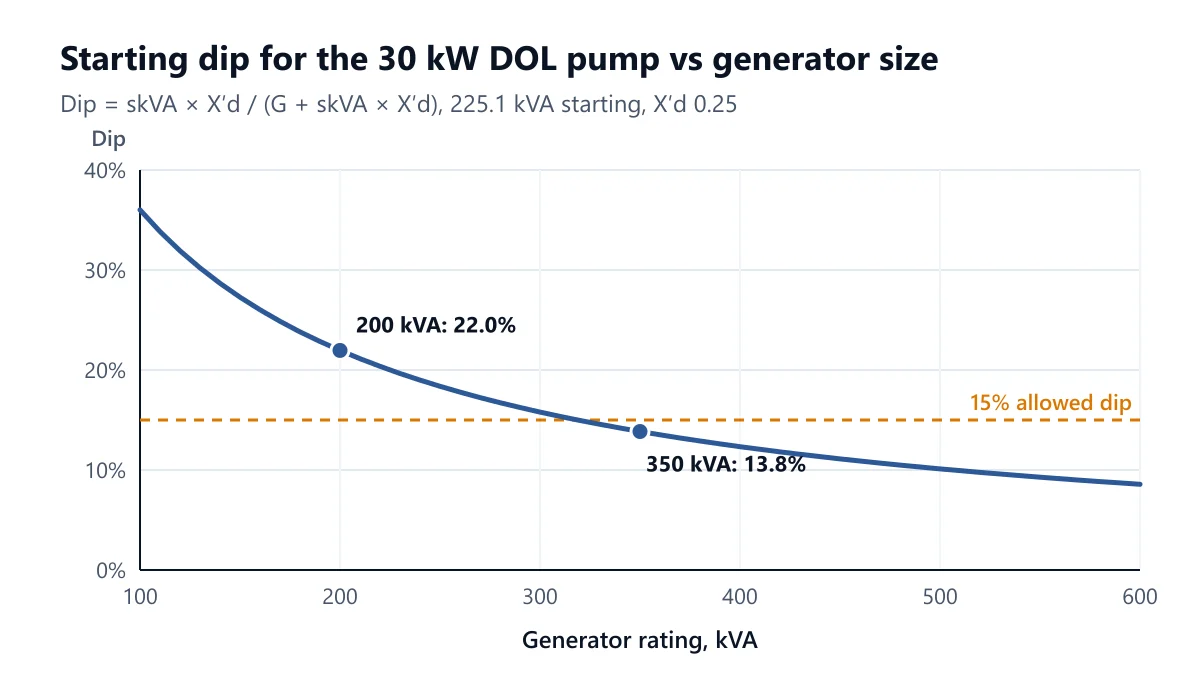
Starting governs. The next common rating above 318.8 kVA is 350 kVA, and on that set the pump's start dips the voltage by 225.1 × 0.25 / (350 + 56.3) = 13.8%, inside the 15% limit.
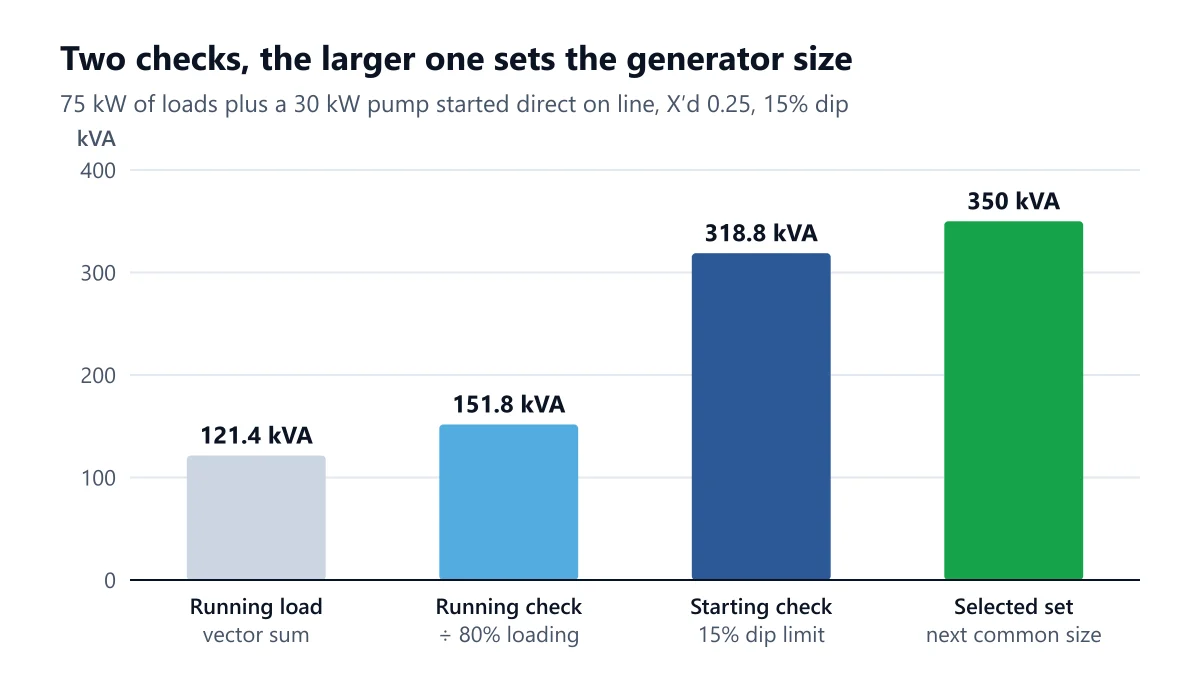
Notice the cost of that answer. The running load is only 35% of a 350 kVA set. The site is buying more than twice the generator it needs to run, purely to start one 30 kW pump.
How the starting method changes the answer
Run the same site with the pump on a different starter:
Direct on line (6 × FLC): 225.1 kVA starting, needs 318.8 kVA, 350 kVA set
Soft starter (3 × FLC): 112.5 kVA starting, needs 159.4 kVA, 200 kVA set, 12.3% dip
Star-delta (2 × FLC): 75.0 kVA starting, needs 106.3 kVA, so the running check (151.8 kVA) governs, 200 kVA set, 8.6% dip
Variable speed drive (1.5 × FLC): 56.3 kVA starting, running governs, 200 kVA set, 6.6% dip
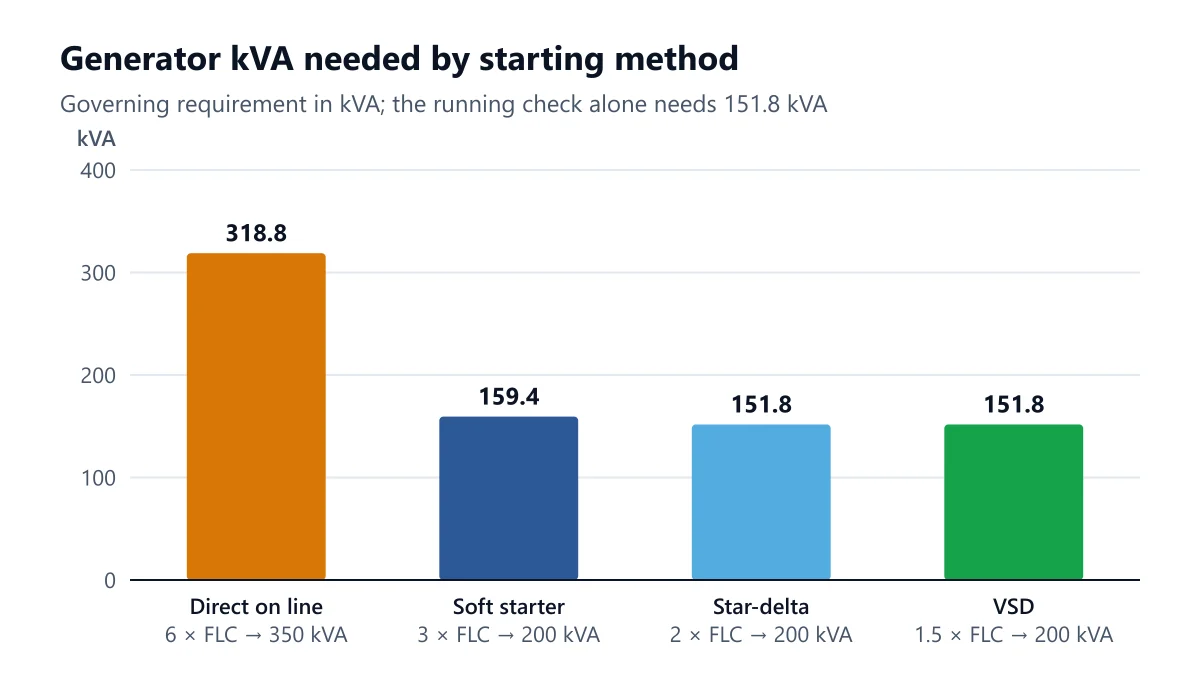
A soft starter on one motor saves 150 kVA of generator. On most standby projects that pays for the starter many times over. Once starting no longer governs, a gentler starter buys nothing more: the star-delta and VSD cases land on the same set because the running load now decides.
Sensitivity to X′d and the dip limit
With X′d = 0.20 instead of 0.25, the DOL starting check drops to 255.1 kVA, a 300 kVA set.
Allowing a 20% dip instead of 15% brings it to 225.1 kVA, a 250 kVA set with an 18.4% dip.
Both are legitimate levers, but only with data behind them: the alternator data sheet for X′d, and the loads' tolerance (contactor drop-out, UPS transfer, lift controllers) for the dip.
What a first-pass calculation leaves out
The voltage-divider method is a good screening tool. It deliberately ignores several things the generator maker's sizing software handles:
Voltage regulator response. The AVR starts recovering the voltage within cycles, so the real minimum may be a little better or worse than the initial dip.
Starting power factor. A motor starts at a poor power factor, typically well under 0.5, so the starting kVA is mostly reactive and hits the alternator harder than the engine.
Engine step-load capability. The engine's ability to accept a block load without excessive frequency dip depends on its design and turbocharging. ISO 8528-5 sets performance classes for transient response.
Step loading. Most standby sites transfer load in steps: the changeover switch picks up the essential board, then motors are started in sequence. The calculator models the worst single step, the largest motor starting with everything else running. If several large motors could start together after a transfer, add a time delay or sequence them, or treat them as one combined start.
Non-linear load. UPSs, VSDs and LED drivers distort the alternator voltage. Sites with a large share of non-linear load usually need a larger alternator than the kVA suggests.
Site derating. High ambient temperature and altitude reduce output. Apply the maker's derating.
Treat the calculated kVA as the size to ask for, then confirm the selection with the supplier's transient analysis before ordering. The electrical installation of the set (changeover, earthing, protection) is covered by AS/NZS 3010 alongside AS/NZS 3000.
Common mistakes
Adding kVA instead of kW and kVAr. Arithmetic sums overstate the load when power factors differ.
Using motor output instead of input. Divide by efficiency first, or the motor's running kVA is low.
Skipping the starting check. A running-load-only sizing for our example would have bought a 200 kVA set that dips 22% when the DOL pump starts.
Grossly oversizing. Diesel sets running for long periods at very light load are prone to wet stacking. If a set will run at 30% load most of the time, fix the starting problem with a soft starter or VSD instead of buying kVA.
Leaving power factor correction connected. A site's capacitor bank, sized for the grid, can push a lightly loaded generator to a leading power factor and destabilise the voltage. Arrange for it to switch out on generator supply, or check with the alternator maker. See our power factor correction guide for how banks are sized.
Forgetting protection. A generator delivers far less fault current than a transformer, which affects whether breakers trip in time. Check the fault loop on generator supply as well as on the grid; our short-circuit current primer covers the basics.
FAQ
What size generator do I need for a 30 kW motor?
It depends almost entirely on how the motor starts. Started direct on line with nothing else running, a 30 kW motor (37.5 kVA running) needs roughly 225 kVA × 0.25 × 0.85 / 0.15 = 319 kVA for a 15% dip on a set with X′d 0.25. With a soft starter at 3 × FLC, about half that.
Should a generator be sized at 80% or 100% of the load?
Size so the running load is no more than about 80% of the set. That leaves margin for steps and growth and suits typical standby and prime ratings. Do not size so generously that the set runs at very light load for long periods.
Why is generator sizing done in kVA, not kW?
The alternator is limited by current, so kVA, while the engine is limited by kW. A generator set has both ratings, usually linked by a 0.8 power factor. Check both: kVA against the running kVA, kW against the running kW. Our kVA vs kW guide explains the difference.
Can I start the biggest motor first to reduce the generator size?
Starting the largest motor before other loads are connected reduces the engine's step, but the alternator still has to supply the starting kVA, so the dip is about the same. The calculator assumes the worst case, with everything else running, which is what happens when a motor restarts after a trip.
Size your generator
Open the Generator Sizing Calculator and enter each load that runs while the largest motor starts, as kW with its power factor. Under Largest Motor, enter the motor's rated output, efficiency, power factor and starting method, and the starting current if you know it. Leave the loading limit at 80%, the dip at 15% and X′d at 0.25 unless you have better data. The result shows the running and starting requirement, which one governs, the next common set size and the dip on it. Get the motor data from the Motor Full Load Current Calculator and the site load from the Maximum Demand Calculator, size the generator cables as covered in sizing cables for commercial and industrial use, or see all the tools in our free electrical calculators guide.
Work it out for your circuit
Free calculators, no sign-up needed.
Related articles
Continue reading more articles on this topic.

Industry KnowledgeAhmed Tayeh
Cable Pulling Tension and Sidewall Pressure: IEEE 1185 Worked Example
How to work out cable pulling tension and sidewall bearing pressure to IEEE Std …
Read more: Cable Pulling Tension and Sidewall Pressure: IEEE 1185 Worked Example
Industry KnowledgeSuheib
Power Factor Correction: How to Size a Capacitor Bank in kVAr
The kVAr a capacitor bank needs comes from one formula, but the steps, the targe…
Read more: Power Factor Correction: How to Size a Capacitor Bank in kVAr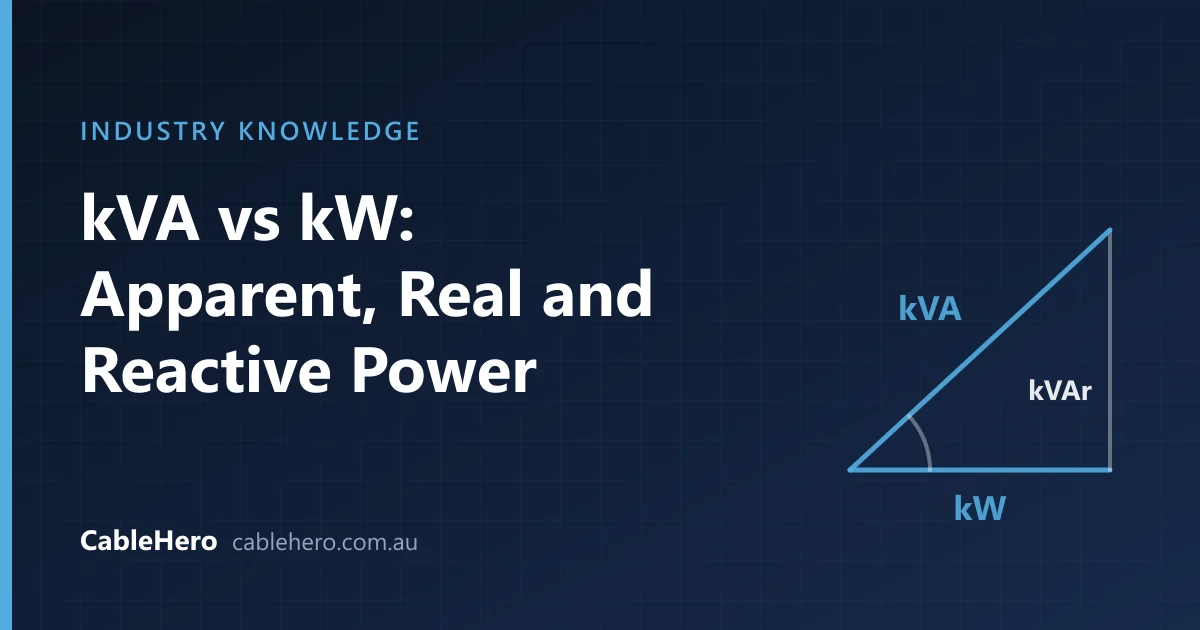
Industry KnowledgeAhmed Tayeh
kVA vs kW: Apparent, Real and Reactive Power Explained for Electricians
kW is the power that does the work, kVA is what the cables and transformers have…
Read more: kVA vs kW: Apparent, Real and Reactive Power Explained for Electricians