
Updated 1 Nov 2026 · Reviewed by Ahmed Tayeh, electrical engineer
What the cable derating calculator does
A cable's current rating in AS/NZS 3008.1.1:2025 assumes one circuit on its own, in still air at 40 °C or in the ground at 25 °C, laid 0.5 m deep in soil of average thermal resistivity. Real installations rarely look like that. The free cable derating calculator reads the cable derating factors for grouping, ambient or soil temperature, depth of laying and soil thermal resistivity from the standard's tables and multiplies them into one combined factor.
Use it when you want to:
- check how much capacity a cable loses on a crowded tray, in a bunched loom or in a shared trench;
- compare the derating of two routes (a hot ceiling space against an underground run) before choosing one;
- find the overall derating factor to enter by hand in a cable sizing calculation or a design report.
The calculator does not pick a cable size. It tells you what fraction of the tabulated rating is left; the cable size calculator then applies that factor and picks the conductor.
Before you start: what to measure on site
Collect these before you open the calculator. Everything else has a sensible starting value.
- Where the cable runs: in air (on a surface, in conduit, on a tray or ladder) or underground (buried direct or in ducts).
- Cable construction: multicore or single-core, and the insulation (V-75 PVC, X-90 XLPE or fire rated).
- Grouping: how many loaded circuits run together, how they are arranged (touching, spaced, bunched, trefoil) and, on cable trays, how many tiers.
- Temperature: the hottest air around the cables, or the soil temperature at cable depth.
- Underground only: depth of laying to the top of the cable or duct, the soil thermal resistivity (from a soil report if you have one) and, for buried direct cables, the conductor size band.
How to calculate cable derating factors, step by step
The calculator has two input cards, Grouping and Temperature (Soil Conditions underground), and recalculates as you change any field.
- 1
Choose in air or underground
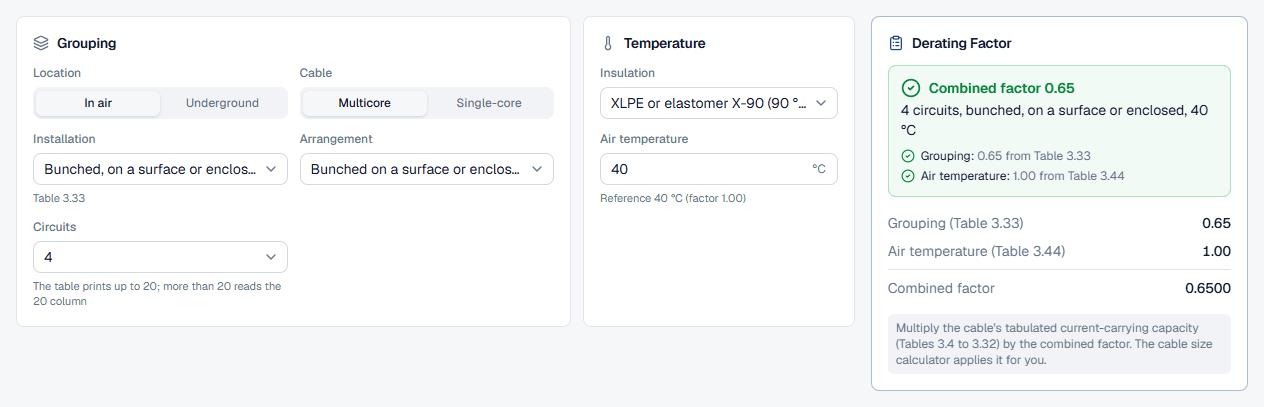
In the Grouping card, set Location to In air or Underground. Switching location also resets the temperature to the reference for that medium (40 °C in air, 25 °C in soil) so you start from a factor of 1.00. Then set Cable to Multicore or Single-core: the two use different grouping tables.
- 2
Pick the installation and arrangement
Installation lists the conditions for the chosen location: Bunched, on a surface or enclosed and On trays, ladders, racks or cleats in air; Buried direct in the ground, Underground ducts, one circuit per duct and Underground ducts, circuits sharing a duct underground. The hint under the field names the table the factor comes from, for example Table 3.33. A condition the standard has no table for (one multicore circuit per duct) is greyed out.
Arrangement then offers the rows of that table, such as Bunched on a surface or enclosed or Single layer on wall or floor, touching. On trays a Tiers field appears and the circuit field becomes Circuits per tier. Pick the number of Circuits; 1 (not grouped) gives a grouping factor of 1.00.
- 3
Enter the temperature
Choose the Insulation (Thermoplastic V-75 (PVC, 75 °C), XLPE or elastomer X-90 (90 °C) or Fire rated (110 °C)). The insulation sets the maximum conductor temperature, which changes how fast the rating falls as the ambient rises. Enter the Air temperature in °C. The hint shows the reference, where the factor is 1.00; a cooler ambient gives a factor above 1.
- 4
Enter depth and soil for underground cables
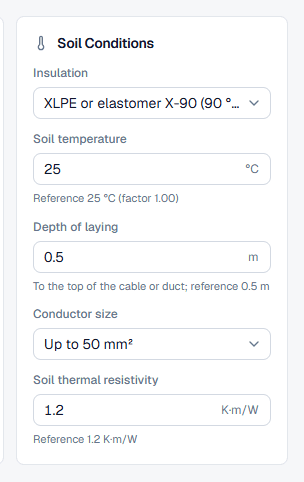
With Underground selected the second card becomes Soil Conditions. Enter the Soil temperature, the Depth of laying in metres (to the top of the cable or duct, reference 0.5 m) and the Soil thermal resistivity in K·m/W (reference 1.2). Buried direct cables also need the Conductor size band, because the depth factor differs for small and large cables. Single-core cables in ducts ask for Single-core cables per duct, 2 or 3.
- 5
Read the combined factor
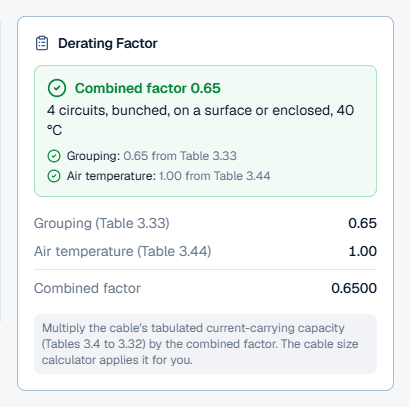
The Derating Factor card on the right updates as you type. Its headline reads Combined factor with the value, and each factor is listed with the table it came from. The next section explains each line.
Reading the derating factor result
- Grouping, Air temperature or Soil temperature, Depth of laying and Soil thermal resistivity: each factor to two decimals, with its AS/NZS 3008.1.1:2025 table in brackets so you can quote it in a design report.
- Combined factor: the product, to four decimals. This is the number you carry forward.
- Amber warning: underground, when a grouping factor below 1 is combined with a depth or soil factor other than 1. The standard's underground grouping factors only hold at the reference depth and resistivity, so the product is then an approximation.
- Grey note: a reminder that the factor multiplies the tabulated current rating (Tables 3.4 to 3.32).
To use the result, multiply the cable's tabulated rating by the combined factor. The derated rating must be at least the circuit's design current.
Worked example: in air and underground
In air: 4 circuits bunched in a hot plant room
Set Location to In air, Cable to Multicore, Installation to Bunched, on a surface or enclosed, Arrangement to Bunched on a surface or enclosed and Circuits to 4. In the Temperature card choose XLPE or elastomer X-90 (90 °C) and enter 45 °C. The result card shows:
A cable whose tabulated rating is 100 A carries 61.8 A in this installation. If the circuit needs more than that, either choose a cable with a higher tabulated rating or spread the circuits out so the grouping factor rises.
Underground: 3 circuits buried direct in warm, dry ground
Switch Location to Underground, keep Multicore, set Installation to Buried direct in the ground, Arrangement to Touching and Circuits to 3. In Soil Conditions enter 30 °C, a depth of 0.8 m, the Up to 50 mm² size band and a resistivity of 1.5 K·m/W.
At 0.8 m and 1.5 K·m/W the combined factor is 0.5997 and the card shows the amber grouping warning. At the reference 0.5 m and 1.2 K·m/W the depth and soil factors are 1.00, the factor is 0.6720 and the warning goes away. When a grouped underground run is far from the reference conditions and the margin is tight, treat the factor as an estimate and have the rating calculated in detail.
Best practice and AS/NZS 3008 references
- Derate the worst section of the route. A cable is limited by its hottest, most crowded stretch, even if that is only a few metres through a ceiling space or a shared riser.
- Count circuits, not cores. The grouping tables are per circuit; three single-core cables of one circuit are one circuit.
- Feed the result into the cable sizing. Enter the combined factor as the Overall derating factor in the cable size calculator, or let its derating assistant read the same tables, so the selected size reflects the installation.
- Record the conditions. Write down the arrangement, temperature and soil values with the tables quoted, so an inspector or the next designer can follow the factor.
Common derating mistakes
Using the outdoor temperature for cables in a roof space
Ceiling spaces, plant rooms and switchrooms are often much hotter than the outside design temperature. Enter the air temperature around the cables.Forgetting other circuits in the group
Existing circuits on the same tray or in the same trench heat your cable too. Count every loaded circuit that runs with it.Choosing the wrong installation table
Bunched cables, tray installations and underground ducts use different tables. Match the Installation and Arrangement to what is actually built.Adding factors instead of multiplying
Two factors of 0.9 give 0.81, not 0.8. The calculator multiplies them for you; do the same if you combine factors by hand.Ignoring the underground warning
If the amber note appears, the grouping factor is outside the conditions it was tabulated for. Allow extra margin or have the rating calculated.