Solar String Voltage Calculator: How Temperature Affects String Voltage in Australia
Every solar panel has a rated voltage on its datasheet. And every solar installer knows that the panel almost never operates at exactly that voltage in the field.
Temperature is the reason.
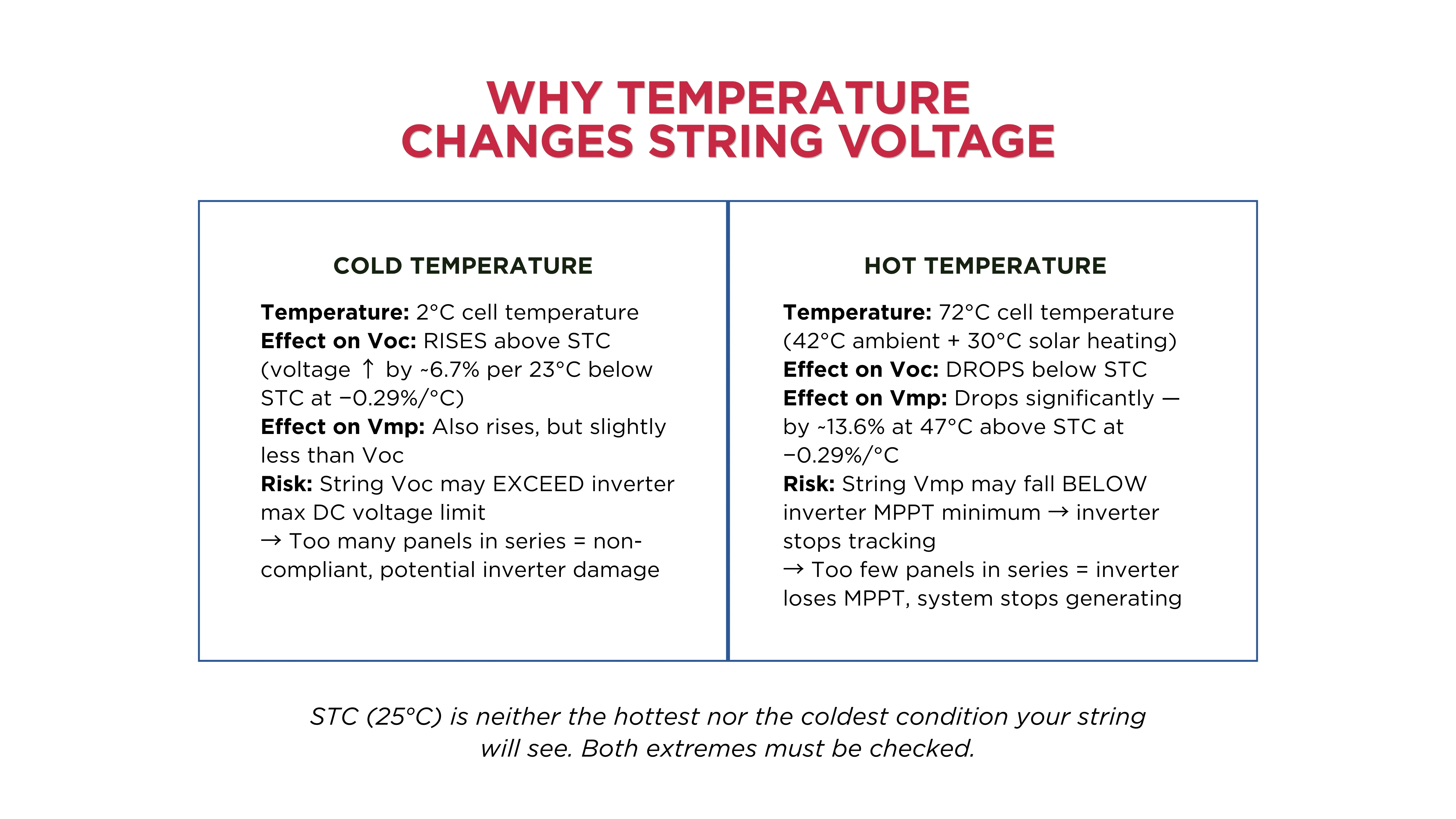
As cell temperature drops, module voltage rises. On a clear, cold winter morning, a PV string can generate significantly higher voltage than its datasheet rating suggests. As cell temperature rises on a hot Australian summer afternoon, voltage falls. If it falls below the inverter's MPPT operating threshold, the inverter loses tracking and the system stops generating.
Understanding how temperature affects string voltage is not optional for compliant solar PV design in Australia. It is the foundation of string sizing, and it governs the maximum number of panels that can be connected in series without violating the inverter's DC voltage limits or the requirements of AS/NZS 5033 and AS/NZS 4777.1:2024.
This guide explains exactly how temperature affects PV string voltage, the formulas for temperature-corrected Voc and Vmp, the four voltage checks every string design must pass, and a complete worked example using real panel and inverter specifications.
Why Does Temperature Affect Solar Panel Voltage?
Solar panels are manufactured from semiconductor materials. Like all semiconductors, their electrical behaviour changes with temperature in predictable ways.
When cell temperature drops below 25°C (Standard Test Conditions):
Open-circuit voltage (Voc) increases above the rated STC value
Maximum power voltage (Vmp) also increases above STC
The panel generates higher voltage than the datasheet rating
When cell temperature rises above 25°C:
Voc and Vmp both decrease below STC values
The panel generates lower voltage than the datasheet rating
At high temperatures, Vmp may fall below the inverter's MPPT minimum
The rate at which voltage changes with temperature is the voltage temperature coefficient. This is expressed as a percentage per degree Celsius (% / °C) or millivolts per degree Celsius (mV/°C). For crystalline silicon modules, typical Voc temperature coefficients are around −0.27%/°C to −0.35%/°C.
The negative sign is critical: voltage decreases as temperature increases, and increases as temperature decreases. This is why temperature correction is not a refinement of string sizing.
What Are the Two Voltage Parameters You Need to Understand?
Voc: Open Circuit Voltage
Voc represents the maximum voltage a solar panel can generate when it's not under load. This is a critical parameter because it indicates the highest possible voltage the panel will produce under the most extreme conditions, such as very cold temperatures.
Voc is the safety-critical voltage parameter. If the temperature-corrected string Voc exceeds the inverter's maximum DC input voltage, the inverter can be damaged. If it exceeds the AS/NZS 5033 installation voltage limit, the installation is non-compliant.
Voc is always higher than Vmp by 15–25% for modern crystalline silicon modules.
Vmp: Maximum Power Point Voltage
Vmp is the voltage at which the panel generates its maximum power under standard operating conditions. It’s the performance-critical voltage parameter. The inverter must be able to track the string's Vmp across the full range of operating temperatures, from the coldest morning to the hottest summer afternoon.
If the temperature-corrected Vmp falls below the inverter's MPPT minimum voltage, the inverter cannot track maximum power and energy yield is lost.
The inverter's MPPT window defines the operating range within which the string Vmp must fall across all expected temperature conditions.
What Do the Australian Standards Require?
Two Australian standards govern string voltage limits:
AS/NZS 5033:2021
The Installation and Safety Requirements for Photovoltaic Arrays sets voltage limits for PV installations based on the accessibility of the system and the installation environment. The practical maximum string length is set by the tightest upper limit from three voltage checks:
Cold-corrected Voc against the AS/NZS 5033 Clause 3.1 limit for the selected installation type
Cold-corrected Voc against the inverter's maximum DC input voltage
Cold operating Vmp against the inverter's MPPT maximum
AS/NZS 5033 specifies maximum PV array voltages by installation class:
Class A Installations: Maximum 600 V DC under the 2014 edition; up to 1000 V DC where additional safety requirements are met
Higher Voltage Systems: 1000 V DC or greater require additional safety measures including arc fault detection, disconnect systems, and installer certification
AS/NZS 4777.1:2024
The Grid Connection of Energy Systems via Inverters sets requirements for grid-connected inverter installations.
Under the updated AS/NZS 4777.1 standards, the transition from 600V to 1000V allows for more efficient designs with longer strings, while commercial systems benefit from larger arrays with streamlined wiring and lower losses.
For residential systems, AS/NZS 4777.1:2024 now permits 1000 V DC string voltages with appropriate system design. This is a significant change from the previous 600 V residential limit that allows longer strings and reduces wiring losses.
What Are the Four Voltage Checks Every String Design Must Pass?
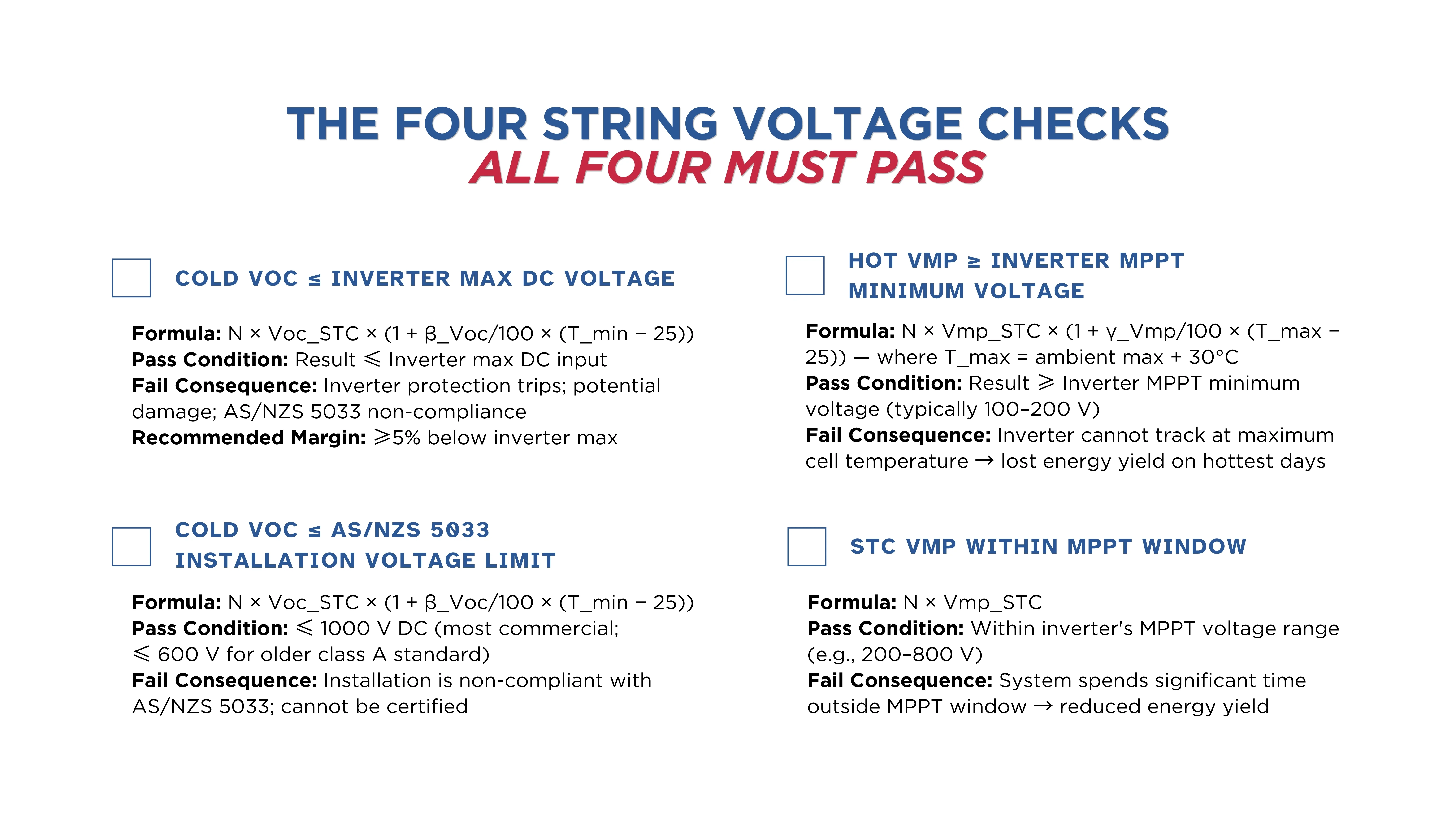
A compliant string design in Australia must pass all four of the following checks. Passing only one or two is not sufficient. C13.3.webp425.41 KB
Check 1: Temperature-Corrected Cold Voc ≤ Inverter Maximum DC Input Voltage
This is the primary safety check. It confirms that on the coldest expected day, the voltage does not exceed the inverter's rated maximum DC input voltage.
Voc_STC = Open-circuit voltage at Standard Test Conditions (25°C, 1000 W/m²)
β_Voc = Voc temperature coefficient (%/°C)—negative value for crystalline silicon
T_min = Minimum expected module operating temperature (°C)
The minimum temperature to use is the minimum ambient temperature at the installation site. Typical crystalline silicon modules have a Voc temperature coefficient of around −0.27%/°C to −0.35%/°C. On cold winter mornings with full sun, string voltage can be significantly higher than the STC rating, potentially exceeding inverter limits if the string is too long.
The result must be ≤ the inverter's maximum DC input voltage.
For residential Australian installations under AS/NZS 4777.1:2024, this limit is typically 1000 V DC for modern string inverters.
A separate but related check confirms that the cold-corrected Voc does not exceed the AS/NZS 5033 voltage limit for the installation class. This check is applied independently of the limit.
For most residential and accessible commercial installations in Australia: Voc_cold ≤ 1000 V DC or ≤ 600 V DC for standard class A installations.
Check 3: Temperature-Corrected Hot Vmp ≥ Inverter MPPT Minimum Voltage
This check confirms that on the hottest expected day, the string Vmp remains above the inverter's minimum MPPT tracking voltage.
Vmp_STC = Maximum power voltage at Standard Test Conditions
γ_Vmp = Vmp temperature coefficient (%/°C)—negative value, similar to β_Voc but may differ slightly
T_max = Maximum expected module cell temperature (°C)
The maximum cell temperature is not the ambient air temperature. Module cell temperature is typically 20–30°C above ambient air temperature due to solar heating. The tool automatically adds +30°C for roof panel cell temperature. For a site with a maximum ambient temperature of 45°C, the maximum cell temperature used is typically 75°C.
The result must be ≥ the inverter's MPPT minimum voltage.
If Vmp_hot falls below the MPPT minimum, the inverter stops tracking during the hottest part of the day, exactly when the system should be producing maximum energy.
Check 4: String Vmp at STC Within the MPPT Window
A final check confirms that the string Vmp at STC operating conditions (25°C, 1000 W/m²) falls within the inverter's MPPT operating range, not just at temperature extremes, but at the standard design condition.
Vmp_STC_string = N × Vmp_STC
The result must be within the inverter's stated MPPT voltage range.
The MPPT window check: the inverter's MPPT operating voltage range must contain the string Vmp at STC. In operation, the cell temperature will almost always exceed 25°C in Australia, lowering Vmp. So, a string Vmp slightly above the MPPT maximum at STC is typically within acceptable tolerance, provided hot-condition checks pass.
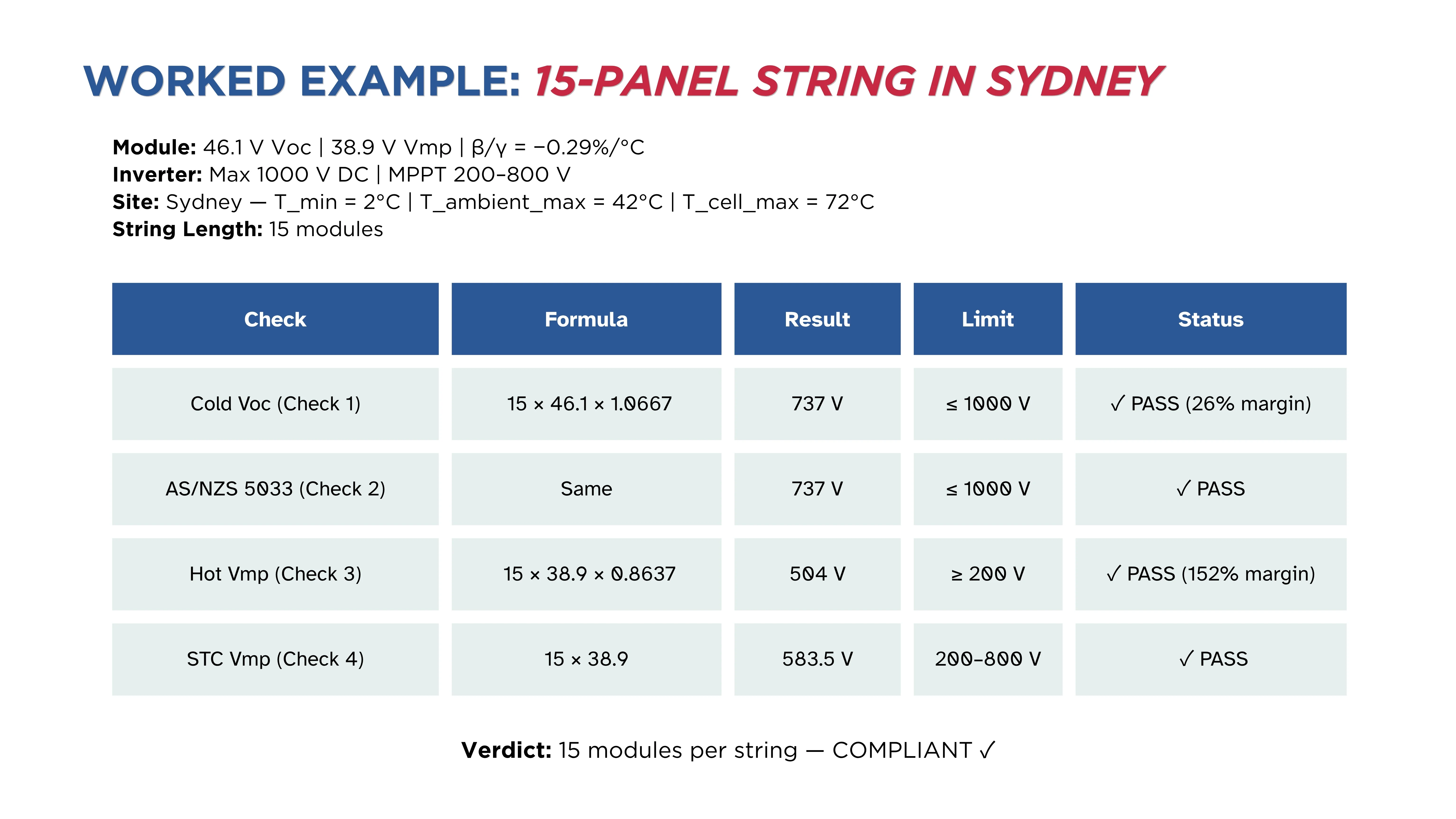
Worked Example: 15-Panel Residential String in Sydney
Inverter can track at maximum temperature Margin = (504.1 − 200) / 200 × 100 = 152%
Check 4: STC Vmp Within MPPT Window
Vmp_STC_string = 15 × 38.9 = 583.5 V
583.5 V is within 200 V–800 V MPPT window ✓
Result: 15 modules per string.
All four checks PASS for this module and inverter combination in Sydney. To maximise the string length: how many panels before Check 1 fails?
Maximum N = 1000 V ÷ (46.1 × 1.0667) = 1000 ÷ 49.17 = 20.3 → maximum 20 modules
At N = 20: Voc_cold = 20 × 46.1 × 1.0667 = 983 V—within 1000 V limit ✓ (narrow 1.7% margin; many designers prefer ≥5% margin as a safety buffer)
What Are the Temperature Considerations Specific to Australian Climates?
Australia's climate diversity creates different string sizing requirements across its regions:
Tropical far north (Darwin, Cairns): Minimum ambient temperatures rarely fall below 15°C, but maximum ambient temperatures reach 38–42°C with high humidity. Cell temperatures can reach 70–75°C. The hot-side Vmp check is the controlling constraint.
Southern highlands and alpine areas (ACT, southern NSW, VIC): Minimum temperatures can reach −5°C to −10°C in winter. A module with a Voc of 45 V at 25°C produces approximately 50–51 V at −10°C. This means cold-side Voc is the controlling constraint and string lengths are limited by inverter maximum input voltage.
Inland arid zones (central Australia, inland WA, SA): Extreme heat produces cell temperatures above 75°C. Vmp can drop by 15–20% from STC values, making the hot-side MPPT minimum check critical. At the same time, clear desert nights can produce low minimum temperatures, so both cold and hot extremes must be checked.
Coastal urban areas (Sydney, Melbourne, Perth, Brisbane): More moderate temperature ranges with cell temperatures of approximately 25–70°C. Both cold and hot checks are relevant but neither extreme is as severe as alpine or arid zones.
Calculate String Voltage in Australia with CableHero
CableHero includes a purpose-built String Voltage Calculator designed specifically for Australian solar PV installations. It applies the exact temperature correction methodology required by AS/NZS 5033 and AS/NZS 4777.1:2024.
With CableHero's String Voltage Calculator, you can:
Calculate temperature-corrected Voc for any module and string length using your site's minimum ambient temperature
Calculate temperature-corrected Vmp at maximum cell temperature, confirming the string remains within the inverter's MPPT window on the hottest day
Check all four voltage limits simultaneously
Pair with the Voltage Rise Calculator to check AC compliance alongside DC string sizing
Generate PDF compliance documentation ready for CER, DNSP, or inspection authority submission
For Australian solar designers, electricians, and engineers, CableHero's String Voltage Calculator ensures every string design is compliant before it's installed. Try CableHero free.
FAQ
How do I calculate the maximum number of solar panels per string in Australia?
The maximum panels per string is determined by the cold-temperature Voc check. The formula is: Maximum N = Inverter Max DC Voltage ÷ (Voc_STC × (1 + β_Voc / 100 × (T_min − 25))). Where T_min is the minimum expected ambient temperature at the site, β_Voc is the Voc temperature coefficient from the module datasheet (a negative value, typically −0.27%/°C to −0.35%/°C for crystalline silicon), and Voc_STC is the open-circuit voltage from the module datasheet at STC (25°C).
What is the Voc temperature coefficient and where do I find it on a solar panel datasheet?
The Voc temperature coefficient (β) describes how open-circuit voltage changes with temperature, typically a negative value between −0.10%/°C and −0.45%/°C, found in the "Temperature Characteristics" or "Electrical Characteristics" section of the module datasheet.
What is the maximum DC voltage for residential solar PV in Australia under AS/NZS 4777.1:2024?
Under the updated AS/NZS 4777.1 standards, the transition from 600V to 1000V for residential systems allows for more efficient designs with longer strings. For residential grid-connected solar PV systems in Australia, AS/NZS 4777.1:2024 now permits 1000 V DC string voltages provided the system design meets the additional safety requirements associated with the higher voltage class.

 Cable Sizing
 Cable Sizing
 Cable Sizing