

28
Nov
By Ahmed Tayeh · Industry Knowledge · 28 Nov 2024
Understanding the Minimum Bend Radius of Cables
Bending a cable too tightly is one of the most common and preventable causes of cable damage on Australian job sites. It often happens gradually, without obvious external signs, and the consequences don't always show up straight away.
× Insulation cracks
× Conductors fatigue
× Shielding breaks down
Eventually, the installation fails. The minimum bend radius is the specification that prevents all of this. Understanding how it works, how to calculate it, and what affects it is a core skill for any electrician or engineer selecting and installing cables.
What Is Minimum Bend Radius?
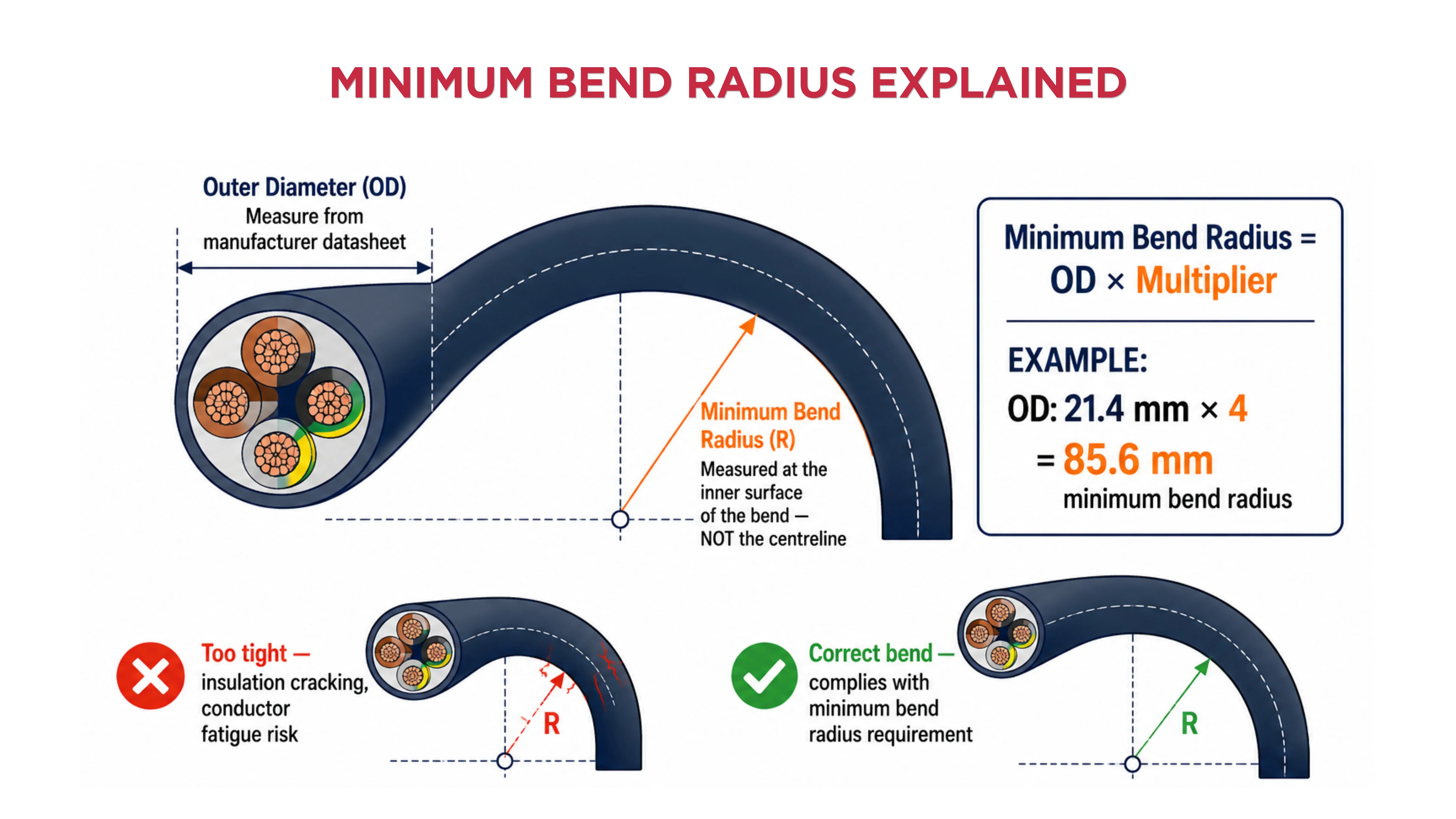
The minimum bend radius is the smallest radius to which a cable can be safely bent without causing damage to its internal structure.
Every cable has one. It's determined by the cable's construction:
- Conductor material
- Insulation type
- Shielding
- Armour
- Overall outer diameter
When a cable is bent beyond its minimum bend radius, the mechanical stresses on the internal components exceed what the materials can reliably handle.
The minimum bend radius is measured at the innermost surface of the bend. This is an important distinction. When calculating whether a bend is compliant, you're measuring the inside curve, not the cable's centreline.
What Is the Minimum Bend Radius Formula?
The standard formula used across the industry is:
Minimum Bend Radius = Cable Outer Diameter (OD) × Cable Multiplier
- Cable OD is the overall outer diameter of the cable in millimetres, taken from the manufacturer's product datasheet
- Cable Multiplier is a factor determined by the cable type and the applicable standard
Worked Example
A 4-core, 16 mm² copper XLPE/PVC 0.6/1 kV cable has an outer diameter of 21.4 mm. For this cable type (fixed installation, unarmoured multicore), the applicable multiplier is 4×.
Minimum Bend Radius = 21.4 mm × 4 = 85.6 mm
This means the inside of any bend in this cable must have a radius of at least 85.6 mm. A tighter bend risks the damage described above. Always check the manufacturer's datasheet for the specific cable in use. The formula gives you the method.
What Factors Influence Minimum Bend Radius?
Four primary factors determine how tightly a cable can be bent:
- Cable Outer Diameter: The OD is directly proportional to the minimum bend radius. A larger cable requires a larger bend radius. This is the multiplier's base.
- Cable Construction: A shielded cable requires a higher multiplier than an unshielded one. An armoured cable has its own requirements. The more complex the internal structure, the more critical the bend radius becomes.
- Insulation and Jacket Material: PVC is more flexible than XLPE at room temperature. XLPE is more flexible than EPR at low temperatures. The material's flexibility directly affects how tightly it can bend without micro-cracking.
- Temperature at Time of Installation: Cold temperatures stiffen insulation and jacket materials. A cable that bends freely at 25°C may crack under the same bend radius at 5°C in a cold morning. Most manufacturers specify a minimum installation temperature, often 0°C or 5°C, below which the cable must not be bent or pulled.
What Happens When You Exceed the Minimum Bend Radius?
Bending a cable tighter than its specified minimum doesn't always cause visible, immediate damage. The effects are cumulative, and they compound over time.
Here's what physically happens inside the cable at each layer:
- Conductors: The strands on the outside of a tight bend are placed under tension. The strands on the inside are compressed. In repeated or dynamic bending (flex applications), fatigue sets in, resistance increases, and eventually conductors fail.
- Insulation: PVC and XLPE insulations are designed for flexibility within limits. Exceeding those limits causes micro-cracking. Those cracks propagate under thermal cycling, compromising dielectric strength and creating a potential shock or fire hazard.
- Shielding: In shielded cables, tight bending causes the metallic tape or braid to buckle on the inner surface and stretch on the outer. Once a copper tape shield cracks, it loses its screening effectiveness and can create sharp edges that damage the insulation.
- Armour: In steel wire armoured (SWA) cables, over-bending can cause the armour wires to separate, lose contact, or bite into the insulation beneath. This compromises both the mechanical protection and the earthing continuity of the armour.
- Outer Jacket: The outer jacket may visibly link or crack immediately, or it may deform without visible damage while the internal components suffer unseen stress.
What Are the Cable Multipliers by Cable Type?
The multiplier applied to the cable OD varies depending on the cable's construction and the conditions under which it will be installed. The table below provides a general guide for common cable types used in Australian electrical installations.
Note that multipliers can vary between standards and manufacturers. The values below reflect general industry practice. Always confirm with the manufacturer's datasheet and the applicable installation standard for the specific cable type.
Key Notes:
- "Fixed" means the cable is installed in a stationary position and will not be flexed during service
- "Flexible/Dynamic" means the cable will be moved, flexed, or subjected to mechanical cycling during service
- Dynamic bend radius multipliers are always higher than static multipliers
- For SWA cables, AS/NZS 3000:2018 and manufacturer guidance should both be consulted; a steel wire armoured cable with an outside diameter of 15 mm requires a minimum internal bend radius of 180 mm in the absence of manufacturer's data, consistent with a 12× multiplier
What Is the Difference Between Static and Dynamic Minimum Bend Radius?
One of the most frequently misunderstood aspects of minimum bend radius is the difference between static and dynamic conditions.
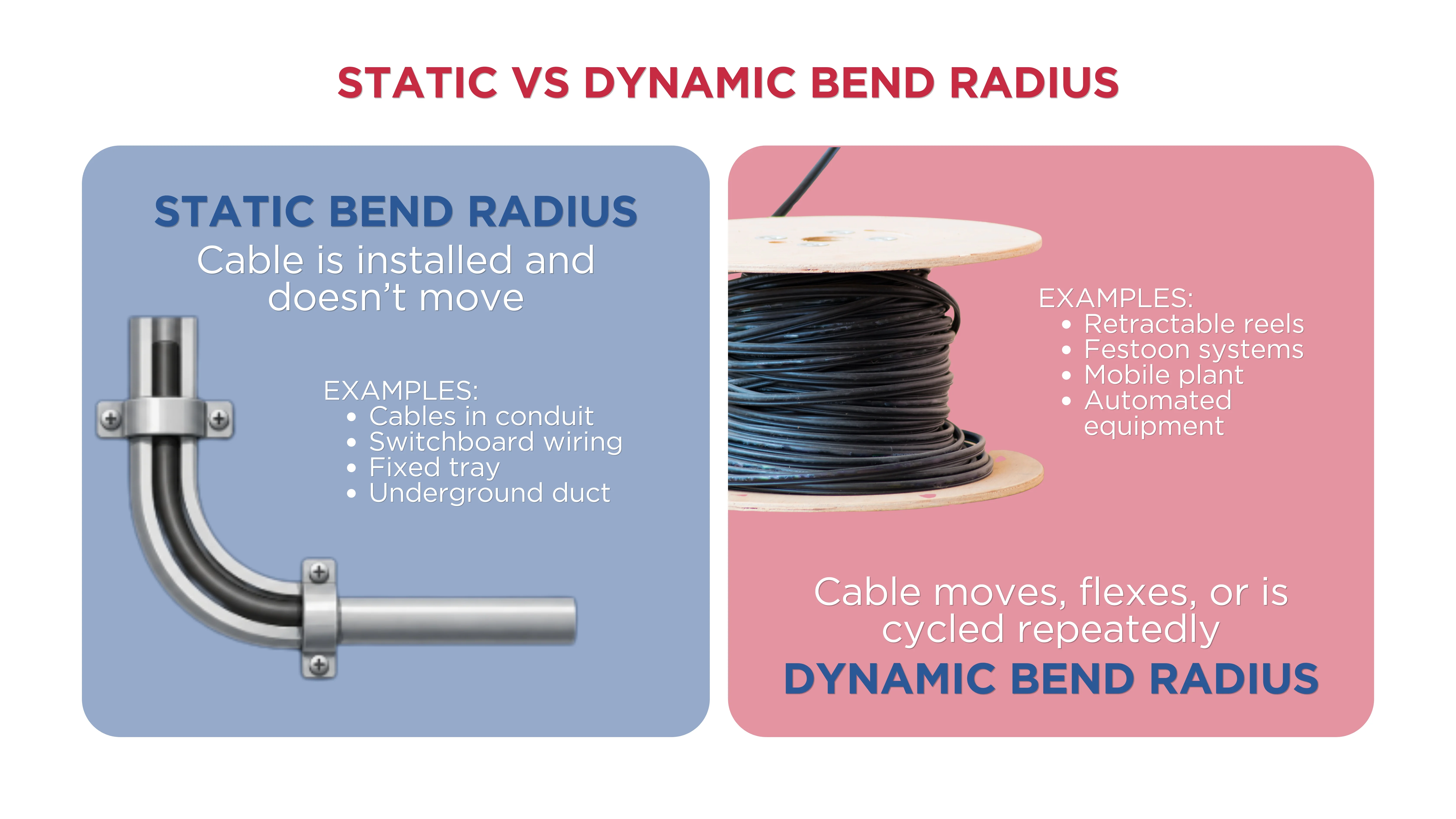
- Static (fixed) Bend Radius. A cable is bent during installation and then remains in that position permanently. The bend is taken once. It is held for the life of the system.
- Dynamic (flexing) Bend Radius. A cable will be flexed, moved, or cycled repeatedly during service. This includes cables on retractable reels, festoon systems, mobile equipment, robot arms, and any other application where the cable moves.
The distinction between static and dynamic bend radius is one of the most consequential aspects of cable design. Static bend radius applies to cables installed in a fixed position that will not move in service.
The practical consequence: a cable specified at 4× OD for static installation may require 8× OD or more in a dynamic application. Using the static multiplier in a flex application is a design error that will lead to premature conductor fatigue and eventual failure.
If a cable will move in service, always confirm the dynamic bend radius with the manufacturer's product documentation.
How Is Minimum Bend Radius Applied in Practice?
Knowing the formula is one thing. Applying it correctly on site is another. These are the practical guidelines that translate the specification into safe installation.
During Cable Pulling
When pulling a cable through conduit or a duct, the cable may be under tension as it rounds a bend. This increases the mechanical stress at the bend point significantly.
The minimum values for the radii to which cables may be bent during installation may not apply to conduit bends, sheaves or other curved surfaces around which the cable may be pulled under tension. Larger radii bends may be required for such conditions.
In manholes, cable pits, and duct transitions, use sheaves (bend formers or pulling guides) rated to the appropriate radius. Never force a cable around a tight conduit bend by pulling through it under high tension.
In Cable Trays and Ladders
When routing cables in trays, bends at tray corners or offsets must observe the minimum bend radius. A cable that visibly links at a tray corner is already damaged. Plan the tray layout before installation to ensure adequate bend radius at every change of direction.
At Switchboards and Equipment Terminations
This is where minimum bend radius is most commonly violated. Cables entering a switchboard are often bent to route around internal components, breakers, and busbars. Installers working in confined spaces under time pressure frequently over-bend cables at this point.
Allow sufficient cable slack inside the switchboard for a compliant bend radius. If the cable diameter makes a compliant bend impossible in the available space, the entry point or cable route needs to be redesigned.
Securing After Bending
Once a cable is routed through a bend, secure it on both sides of the bend with appropriate clips or saddles. An unsupported cable can straighten under its own weight, pulling the termination and placing ongoing mechanical stress at the bend point.
On Cable Reels
To install cables safely without damaging the electrical and physical properties of the cables, the tabulated minimum bending radius must be observed.
For cables stored or used on reels, the drum diameter must accommodate the cable's minimum bend radius. Drums that are too small for the cable diameter will over-bend the cable with every layer wound onto the drum.
Size and Select Cables Confidently with CableHero
Getting minimum bend radius right starts with selecting the right cable for the job. CableHero is professional cable sizing software built specifically for Australian electricians and engineers, aligned with AS/NZS 3000:2018 and AS/NZS 3008.1.1.
With CableHero, you can:
- Size cables accurately for any installation method, load type, and circuit length
- Apply AS/NZS correction factors automatically for ambient temperature, grouping, and thermal insulation
- Generate compliant PDF cable schedules and documentation ready for certification and DNSP submission
- Work confidently knowing your results are referenced against Australian standards
Whether you're designing a residential fit-out, a commercial submain, or a solar PV installation, CableHero takes the calculation burden off your hands.
Register at CableHero to try the cable sizing software and its features for free.
FAQ
What is the minimum bend radius of a cable and how is it calculated?
The minimum bend radius is the smallest radius at which a cable can be safely bent without damaging its conductors, insulation, shielding, or armour. It is calculated using the formula: Minimum Bend Radius = Cable Outer Diameter (OD) × Cable Multiplier.
Does minimum bend radius apply differently for flexible vs. fixed cables?
Yes. Cables that will be flexed or moved during service (dynamic applications) require a higher multiplier than cables installed in a permanently fixed position (static applications). Using a static multiplier in a dynamic context is a common design error that leads to premature conductor fatigue and installation failure.
What happens if you bend a cable tighter than the minimum bend radius?
Exceeding the minimum bend radius causes progressive damage to the cable's internal structure. The damage is often invisible externally and may not produce an immediate fault. But it reduces the cable's service life significantly and can create latent safety hazards that develop over months or years of operation.
Tags:installationbend-radiuscable-handling
Related Articles
Continue reading more articles on this topic.
 Industry Knowledge
Ahmed Tayeh 13 Oct 2026
Single Line Diagram for Commercial Buildings: A Step-by-Step Guide
A single line diagram is the backbone of every commercial electrical design, sho…
Read More → Industry Knowledge
Ahmed Tayeh 01 Sept 2026
How to Read a Single Line Diagram: A Complete Guide for Electricians and Engineers
Single line diagram (SLD) explained; how to read symbols, trace power flow, iden…
Read More → Industry Knowledge
Ahmed Tayeh 30 June 2026
Top 10 Cable Sizing Mistakes and How to Avoid Them
Cable sizing looks easy until you look closer. Here are common cable sizing mist…
Read More →